
**This research was first published in the May 6, 2026 edition of the Chatham Star-Tribune newspaper as part of Kyle Griffith’s weekly segment entitled “Heritage Highlights.”
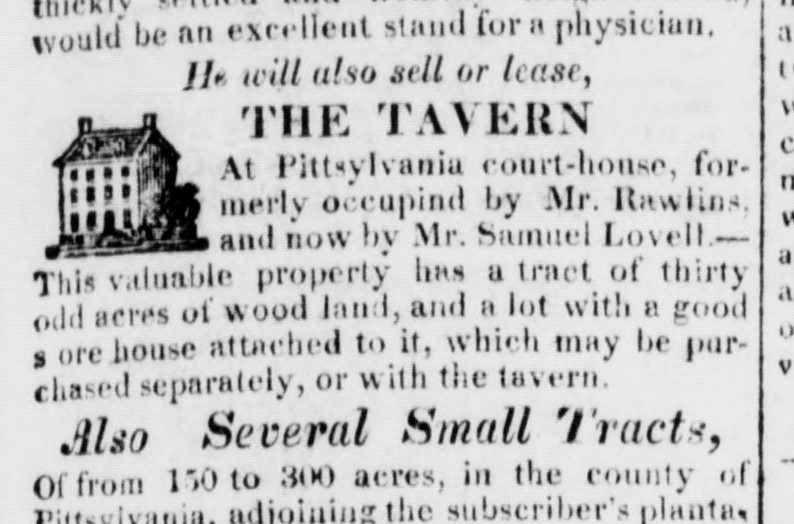
Excerpt of 1822 article by George Tucker selling the tavern at Pittsylvania Court-House
When lots were sold to establish the county seat at Cherrystone Creek in 1807, one of the first businesses constructed was a tavern. William Rawlins (born around 1764) offered food, drink, and lodging to attorneys, store clerks, farmers, and other travelers in town. It was located near 26 South Main Street (now Shade Tree Rare Books) where a cluster of frame buildings and outbuildings supported the work of a tavern. The building is long gone, with no known depictions surviving, but old newspaper articles provide enough detail to piece together a short history of the early tavernkeepers.
In an edition of the Lynchburg Press (Volume 6, Number 28) from November 10, 1814, county clerk William Tunstall advertised “his lots and houses of public entertainment in the town of Competition, at Pittsylvania Court-House, lately occupied by Mr. William Rawlins. The dwelling house is roomy, and well constructed for a Tavern–the out houses are convenient–and there is also a very productive garden.” He further noted an adjoining tract of land where “convenient horse lots may be got, and fire-wood and rail timber within a very convenient distance of the tavern. There is also a convenient Store House on one of the lots, and in the centre of the town…” After keeping the tavern for several years, Rawlins turned his focus to Danville, where he managed Bell Tavern a few years later.
An article from the Virginian (Volume 1, Number 14) on September 20, 1822 features an advertisement from the lot owner at the time, George Tucker. He referred to “THE TAVERN at Pittsylvania court-house, formerly occupied by Mr. Rawlins, and now by Mr. Samuel Lovell.” The new tenant, Samuel M. Lovell, was born around 1768. He first married Miss Sarah Carter, a daughter of Thomas Carter of nearby Green Rock, but she passed away while in her thirties. He remarried in 1811 to Miss Joanna White, a daughter of Dr. Rawley White. On January 13, 1824, Tucker ran a very similar article in the Virginian (Volume 2, Number 45) though this time the tavern was “occupied by Mr. Samuel Edmundson, and leased to him for two years.” Edmundson appears to have completed the term and passed away shortly afterward in 1826.
Lovell was referenced again as manager several times afterward, including when he put the desirable properties up for sale. In the Lynchburg Virginian (Volume 14, Number 61) from February 22, 1836, Lovell advertised “my TWO LOTS, at Pittsylvania Court House, which I have, for a number of years, occupied as a tavern-keeper. The improvements are well calculated for that business being a large new two-story wooden house, with two rooms above and below, convenient passages, and a good cellar, intended as a dining room.” Beside it, he described a house “with six rooms, used principally as the tavern-house.”
He also offered “a new house, with two rooms, now occupied as law offices” and a building “with four rooms, formerly occupied as a store-house.” The property included a smoke house, ice house, kitchen, quarters, and large stables for up to one hundred horses. He stated “these lots contain half an acre of ground each, are well enclosed with palings, and one of them is a most excellent garden.” Lastly, he described a thirty-six-acre tract adjoining the town, “partly cleared, with three or four good lots, suitable for entertaining droves of horses, &c., or for cultivation, and has on it a newly built hewed log house, with framed and shingled roof, a good blacksmith shop and other cabins.”
References to taverns around Chatham largely disappeared from the newspapers during the 1830s. Sometime before 1850, the property was purchased by James Carter, a nephew of Lovell’s first wife, Sarah Carter. Around that time, a more modern brick building was constructed at the corner of Main Street and Court Place. Instead of a tavern, it became known as a hotel and offered many of the same services. The former tavern of Rawlins and Lovell, alongside Davis’ Tavern, Callaway’s Tavern, and possibly others, were among the most important establishments in town during their time.