

**This research was first published in the May 13, 2026 edition of the Chatham Star-Tribune newspaper as part of Kyle Griffith’s weekly segment entitled “Heritage Highlights.”
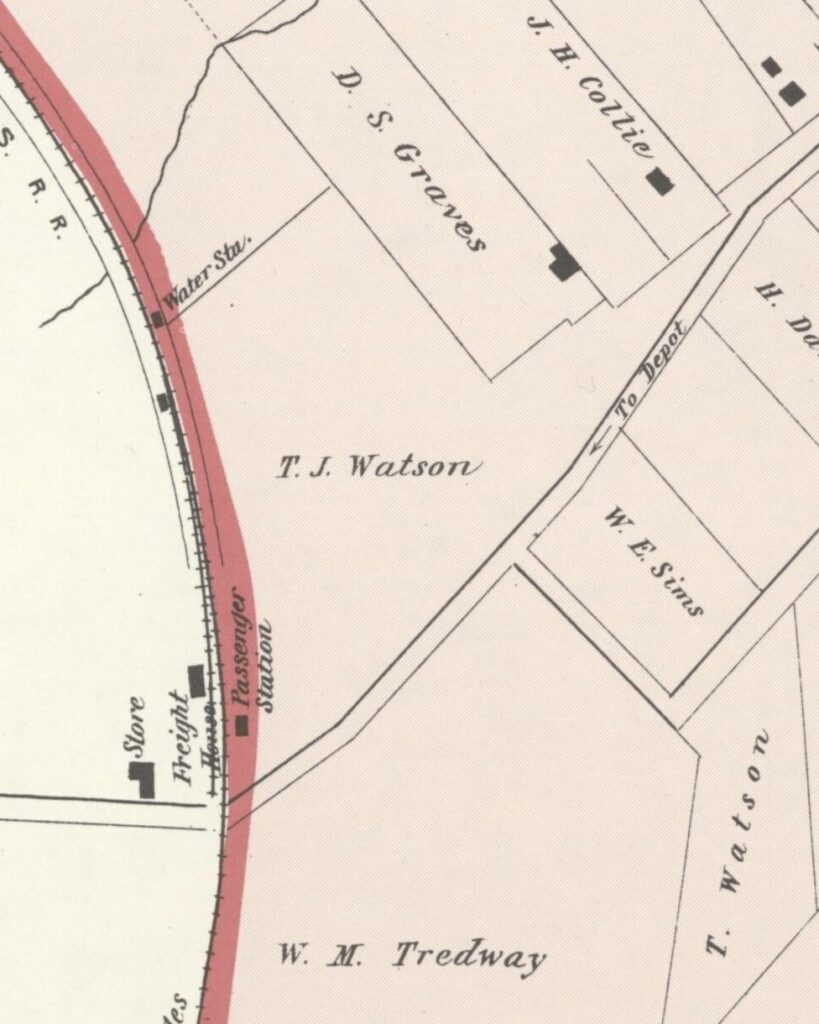
1878 Gray’s Map of Chatham (cropped) showing buildings at the railroad and landowners
In May 1873, a traveling correspondent from Richmond, Virginia wrote a valuable description of Chatham that was published in the Daily State Journal (Volume 5, Number 172). The writer, Daniel S. Curtiss, had previously worked as a journalist in Chicago and wrote several books involving his travels throughout Wisconsin, Illinois, Iowa, Minnesota, and other western territories. He wrote about agriculture and husbandry, and his work eventually brought him to Virginia. He visited Chatham and recorded the character of the community shortly before its transition from courthouse village to depot town. The local railroad line was being constructed as part of the Virginia Midland system, and Chatham was formally incorporated as a town the following year in 1874.
The Chatham newspaper at the time, the Pittsylvania Tribune, had the following to say about the writer: “Mr. D. S. Curtiss…who has been in our village for several days, called upon us on yesterday. This gentleman is making an active and thorough canvass of the state for the purpose of collecting the most prominent facts in regard to the past history of every county, town and village that he can conveniently reach, their present material condition and general advantages in all respects, which are published in letter form in his paper…”
Curtiss began his description and remarked: “It is interesting to see the long train of covered wagons, and other country teams, file into this thrifty little village, loaded with tobacco and grain, from all parts of the county, there being no railroad station nearer than about twenty miles; and still this is a large tobacco centre. But the people are hopeful and happy in the sure prospect of soon enjoying railroad facilities, by the speedy completion of the Lynchburg and Danville railroad. On the invitation of Major Ward, superintending engineer of this section, I took a look over a portion of the work, and learn from him that the heavy cutting and nearly all the grading is done, and the line will soon be ready for the iron, and other equipments.” The new construction helped shape the development of Depot Street, which at that time had only two houses along the south side and about four more on the northern side, set farther back from the road. Details from the Gray’s Map of Chatham (1878) show that the line was completed and paired with a passenger station, freight house, store, and water station.
Curtiss was impressed by the “extensive tobacco manufacturing” around town. “Some of the largest yields, of best tobacco, ever known, has been raised in this county. Among the enterprising firms, whose factories I visited, was that of J. H. Collie & Co., industrious and reliable young men, who have recently established a business here. There are two other factories; with shops for making boxes and hogsheads; all of which afford employment, at fair wages, to many men, women and children. Much good tobacco is brought to this place from Henry county, which is said to be the best chewing tobacco raised anywhere. Good tobacco is also wagoned here from Franklin county; and when the railroad is completed to this point it will be the regular market for a large region of country.”
The article closed with a positive reflection about the local settlers and the availability of good farming land. “The Chatham Tribune,” as Curtiss called it, “is a live paper, published in this village, by Messrs. Tredway & Watson, and deserves the liberal support of the place.” The Gray’s Map further shows that the Tredway and Watson families owned most of the land along the railroad tracks, and that the home of J.H. Collie was nearby. It is unfortunate that Curtiss did not devote more space to his multi-day tour of Chatham, but what he did write remains especially valuable after all this time.