
**This research was first published in the April 8, 2026 edition of the Chatham Star-Tribune newspaper as part of Kyle Griffith’s weekly segment entitled “Heritage Highlights.”
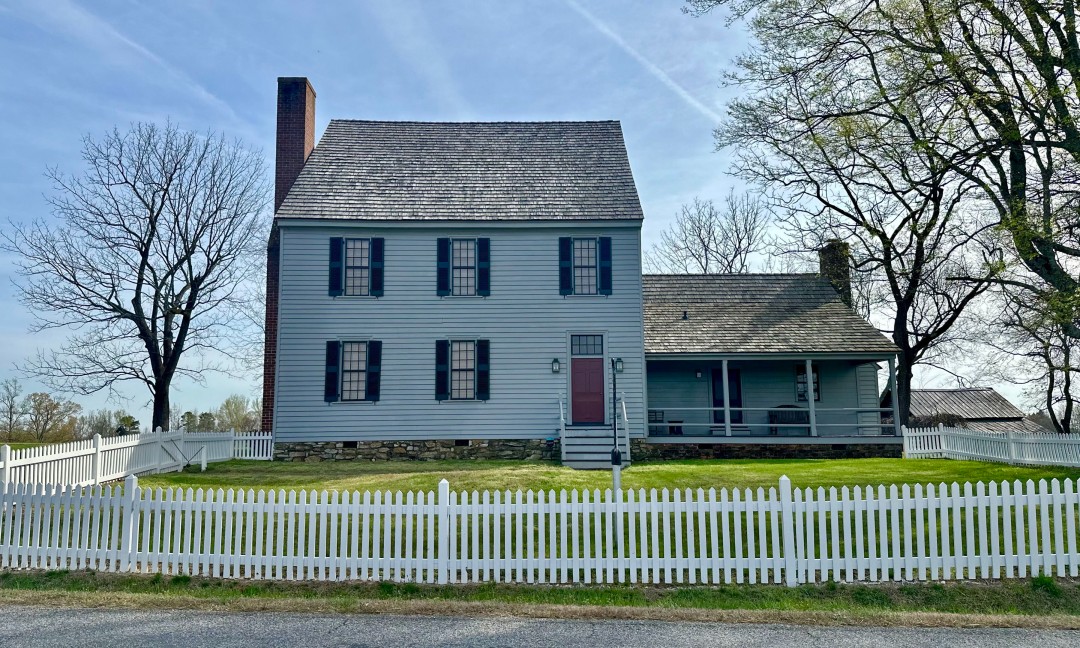
Carter’s Tavern, Halifax County, photo by Kyle Griffith 2026
Pittsylvania County has many old roads where remnants of earlier times still linger, especially toward the eastern boundary. Numerous deep-rooted families can trace their ancestry to Halifax County before the Revolution, when colonists were settling the frontier lands between the Banister River and Dan River. Notable examples of historic architecture and rural landscapes remain along Birch Creek. During the last two hundred years, the Laurel Grove community and its vicinity have been associated with families such as Banister Anderson, Beverly Barksdale, William Chaney, Elijah Dodson, Joshua Hightower, and Dr. Thomas Wistar White, among other early landowners. Family cemeteries are dotted along the local roads while others are situated to the back of well-maintained farmhouses. Beneath canopies of great trees intermingled with boxwoods, phlox, and periwinkle, many of the burial sites contain unmarked fieldstones of unknown ages.
As one passes into Halifax County, Laurel Grove Road becomes Brooklyn Road. A little more than two miles past the county line, the eye-catching Brooklyn Store and Post Office sits vibrantly restored on the northern side of the road. Tax records referenced in the building’s National Register nomination suggest that William Easley had the store constructed around 1850. It likely replaced an older store that had housed the community’s post office since 1831. Easley sold his 438-acre tract to Beverly Barksdale II in 1850, who was elected postmaster that same year. Barksdale’s father ran a tavern at Peytonsburg. Through his mother’s family, he was a first cousin to Allen W. Womack of Banister Heights. Barksdale’s son and grandson were also elected to serve as postmaster of Brooklyn around the turn of the twentieth century. The office was discontinued in 1903 and passed its mail to Sutherlin in Pittsylvania County.
Less than half a mile farther east, a similarly aged structure called Brooklyn Tobacco Factory remains standing. It is a grand but simple brick structure, with two full stories and a large half-story within the roof. There are fourteen windows on each long side of the building, and an off-center entryway. It sat abandoned with most of its windows missing for many years until it was restored and listed on the National Register of Historic Places in 1996. Details from the National Register nomination reveal that the structure was commissioned by Beverly Barksdale II and Joshua Hightower. The two families were united in 1854 when Joshua’s daughter Susan Hightower married Beverly Barksdale III, who managed the factory. Plug tobacco was manufactured throughout the 1850s, but they were compelled to stop throughout the duration of the Civil War. Operations picked up afterward and continued until the early 1880s.
Another half-mile east stands Carter’s Tavern, a relic of colonial times. The building was constructed in two distinct sections and has been painted pale blue-gray. A white picket fence encases the front yard, and a historical marker (U-47) indicates that the smaller section of the house was constructed as a dwelling for Joseph Dodson Sr. sometime before his death in 1773. He is considered a patriarch of many local Dodson family lines. His home was a traditional one-and-a-half story cabin dwelling. It features a roof that extends downward directly into the porch roof on the front and back sides. In 1807 the property was sold to Samuel Carter (born around 1773). Around the same time the building was enlarged with a two-story addition intended to open as a tavern. Carter ran the tavern for nearly twenty years until his death in 1836. Afterwards, his widow Elizabeth assumed the role of tavernkeeper for the remainder of her life, until 1843. Their grandson James M. Neal later served as postmaster of Danville, VA during the 1890s. Behind the tavern, a log building stands in line with two small frame outbuildings with pyramidal roofs. Just west of the building is a burial ground for several Civil War veterans and more recent generations. The tavern was faithfully restored in 1972 by Mr. Robert Edmunds and his wife. The road trip described here is short but the stories are long.