

**This research was first published in the April 15, 2026 edition of the Chatham Star-Tribune newspaper as part of Kyle Griffith’s weekly segment entitled “Heritage Highlights.”
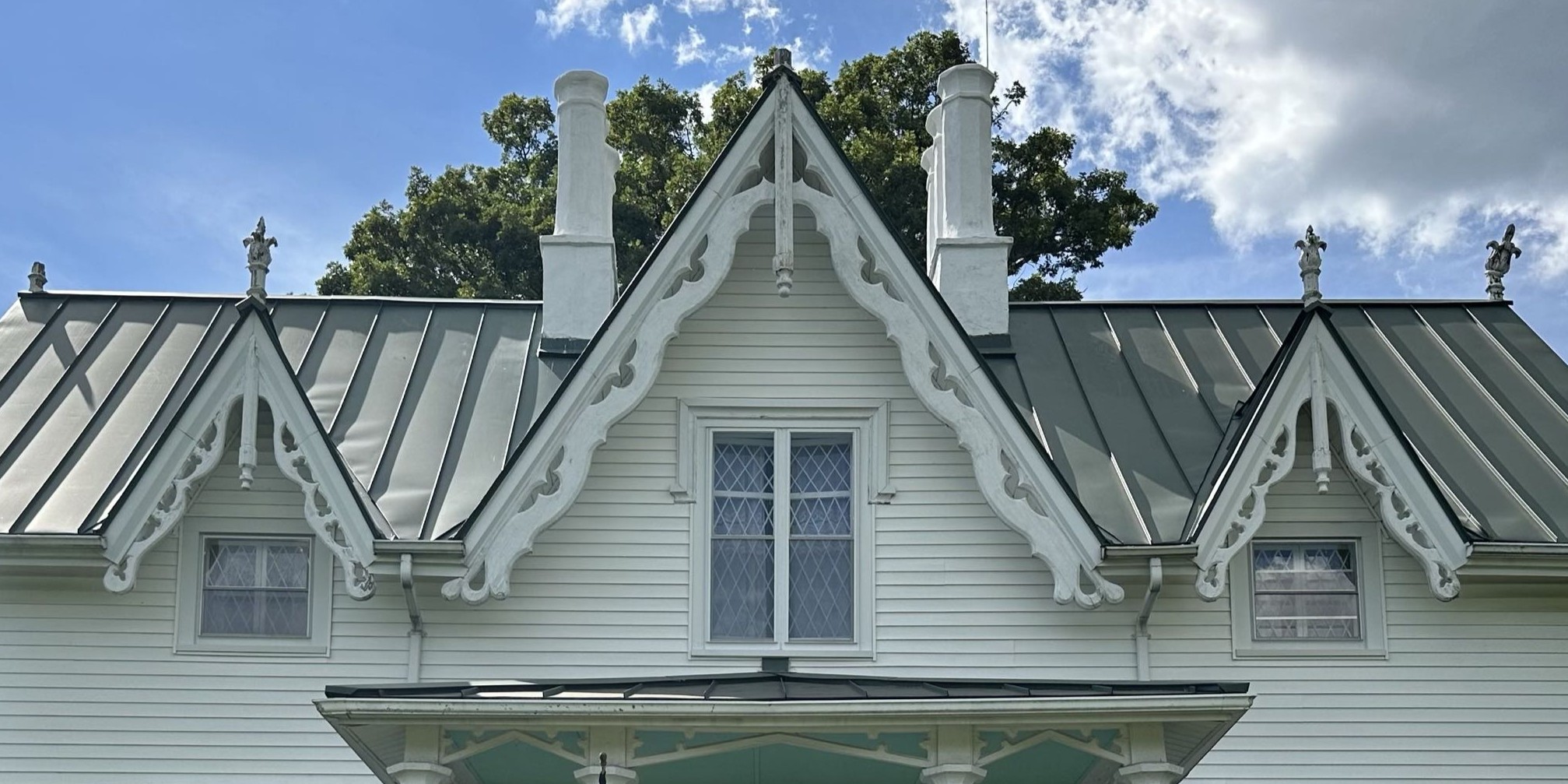
Two bargeboard designs with finials at Sharswood, photo by Kyle Griffith
During the mid-to-late 1800s, carpenters across the United States were influenced by Gothic architecture and incorporated certain elements into many homes across the countryside. There was a resurgence in appreciation for the Gothic style found in late Medieval structures across Europe, especially in France and Germany. Several noteworthy buildings of Gothic Revival and Carpenter Gothic influence were constructed in Pittsylvania County around the Mt. Airy community. Alongside steeply pitched roofs and pointed window forms, one feature in particular stands out and makes these homes easy to identify. During the mid-19th century, it was stylish to attach decorative wood trim to the eaves of the roof, sometimes with intricately carved woodworking. This trim, known as bargeboard or vergeboard, typically follows the gable in a repeating pattern up to the peak. The word “barge” derives from the Middle English word “berge,” meaning “sloping roof.” In addition, bargeboards usually connect at a decorative finial, which is an ornamental piece projecting from the gable peak. Examples can be seen in many locations across Virginia and other states. In the town of Chatham, the historic house at 125 Reid Street illustrates these elements clearly: a steeply pitched Gothic roof with decorative bargeboard and tall finials. The home was constructed in 1851 for chancery clerk Griffith D. Neal.
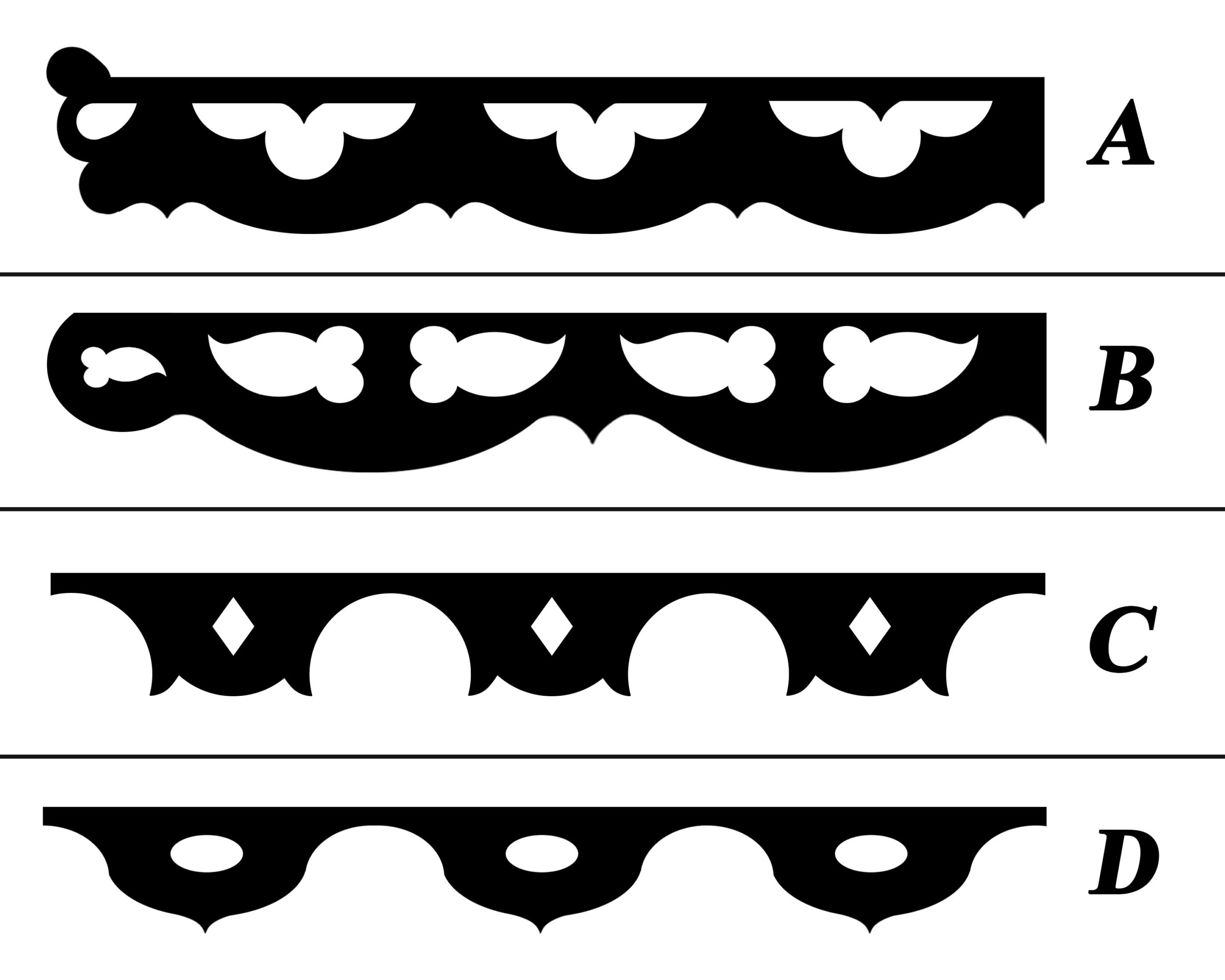
Bargeboard patterns found in historic architecture around Mt. Airy, drawn by Kyle Griffith
Near Mt. Airy, the most well-known home with Gothic elements is Sharswood, which gained national attention in 2022 when it was featured in a TV documentary by “60 Minutes.” The plantation home was constructed during the 1850s for brothers Charles E. and Nathaniel Crenshaw Miller. The front face of Sharswood features two different bargeboard patterns within three gabled projections of the roof. The accompanying image shows four bargeboard designs that have been digitally reproduced and labeled A, B, C, and D. The central section of Sharswood (A) resembles a curly bracket with a series of shallow curves and a pointed tip or cusp between them. Near the top edge is a cutout shape reminiscent of a Gothic quatrefoil motif. It is shaped like the bottom half of a four-leaf clover design, with a cusp at the top center. At the apex of the roof, the decorative finials were topped with figures of the French fleur-de-lis. The two smaller roof projections on the front feature a bargeboard design (B) with a similar rounded bracket, but the curves and cusps are slightly fuller than example A. Each segment features two mirrored cutout designs, each with a rounded three-leaf design, with one section tapered like a curved water droplet. Both A and B feature shaped designs at the ends of the bargeboard that contain a smaller or simplified version of the cutout. A third design is featured on the sides of the home.
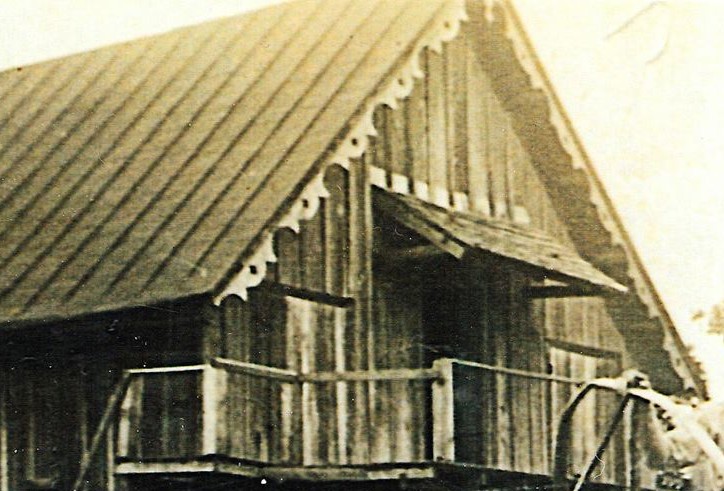
Creasy’s Store (C) cropped to show bargeboard detail
The old Creasy’s Store was located just up the road from Sharswood and an old photo reveals its Gothic elements. It could have been constructed before G.A. Creasy was appointed postmaster of Mt. Airy in 1875, or sometime thereafter. The exterior board-and-batten walls retained their natural wood color, sun-scorched by the time of the new century. The store’s bargeboards (C) featured large semi-circle arches, separated by a round dipping shape with two thorn-like protrusions. Between each arch a small, simple diamond-shaped cutout completes the design. The pattern simply terminated at the edges without a special end-cap design.
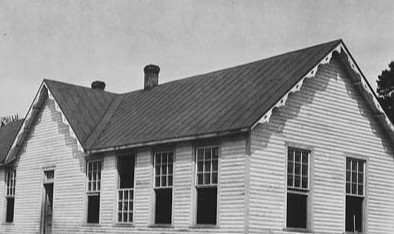
Mt. Airy School (D) cropped to show bargeboard detail
Even those who built the former small frame schoolhouse at Mt. Airy included Gothic elements. Compared to several hundred photos of other local schools, Mt. Airy School appears to have been the only one in the county with bargeboard. Similar to Creasy’s Store, the design was made up of semi-circle arches, but a shallower oval shape in comparison. Between each arch, an oblong protrusion featured a central cusp. Details from two old images of the school were not sharply defined, but it appears that the cutout was a simple wide oval shape. There was no finial, and the rest was built as a standard two-classroom schoolhouse. Whether the school and store were inspired by Sharswood or the overall theme from the era, the carpenters of past generations have left many expressive examples of their bargeboard to be studied today.