
**This research was first published in the June 10, 2026 edition of the Chatham Star-Tribune newspaper as part of Kyle Griffith’s weekly segment entitled “Heritage Highlights.”
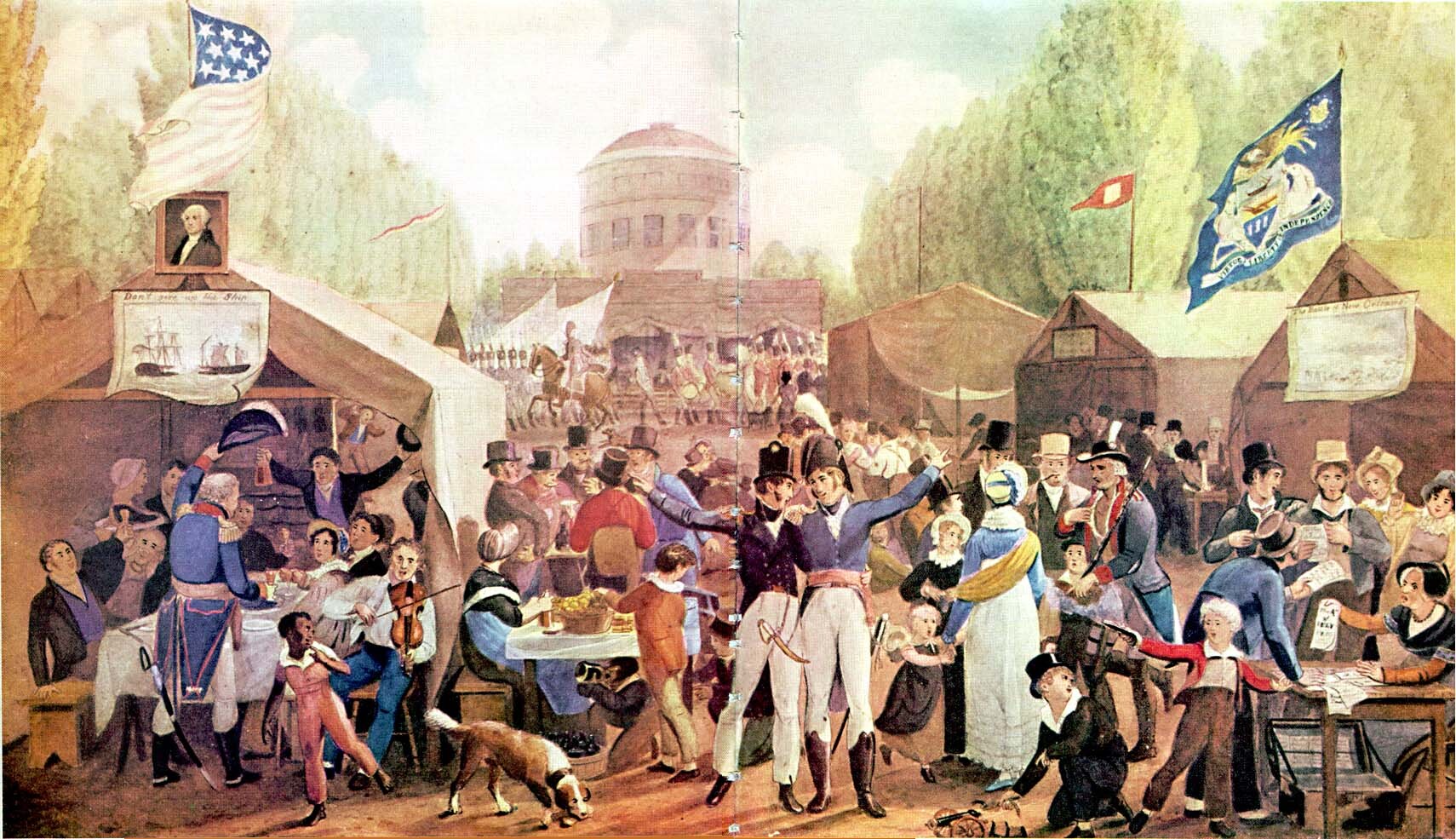
Fourth of July Celebration in Centre Square, Philadelphia (1819) by John Lewis Krimmel (Wikimedia Commons)
On July 4, 1827, Pittsylvania County marked the 51st anniversary of American independence with a formal celebration at the county courthouse, then located near the site of the present Town Hall. An article in the Richmond Enquirer (Vol. 24, No. 23) gave the names of nearly forty men connected with the event, among them Dr. George Craghead, Rev. Griffith Dickenson, Pyrant Easley, Thomas S. Jones, William L. Pannill, Col. Thomas Ragsdale, Maj. James Soyers, Whitmell P. Tunstall, Dr. Rawley White Sr., Hugh Wier, Col. Robert Wilson, Robert Witcher, and Capt. T.W. Wooding.
The column mentions that “Mr. Nathaniel W. W. Kerr, after a few appropriate remarks, read the Declaration of Independence. He was followed by Daniel George Tucker, Esq. who delivered to a delighted audience of gentlemen and ladies an oration highly creditable to himself and worthy of the occasion. The company then repaired to the Tavern of Mr. Samuel M. Lovell, who had prepared a tasty and sumptuous entertainment, at which William Tunstall, Esq. presided, assisted by George [Townes], William R. Chaplin and Walter Coles, Esqrs. as vice presidents.”
In the tavern, the presiding men raised thirteen toasts, each followed by a tune played. They raised a glass, stating “The day we celebrate. May its annual return be hailed with increased joy with all succeeding generations.” The first song, Hail Columbia (also known as “The President’s March”), was originally composed for the inauguration of George Washington in 1789. The second toast honored “The Union of the States,” followed by the song Free and Accepted Masons, which was over a century old by that time, and many of those attending were members of the local masonic lodges. The third toast stated, “The Constitution of the U.S. May it cease to be construed, so to advance the interest of the few, at the expense of the many.” Their cheers were followed by a rendition of Jefferson’s March, a tune published in 1804. Fourth, they toasted the “Army and Navy of the United States,” followed by the Star-Spangled Banner. It’s notable that the song was only thirteen years old by that time, and played more than a century before it was officially adopted as the national anthem.
Next, they toasted George Washington and chose a song from his presidency called General Washington’s March (or Washington’s Grand March). The sixth toast was given to “The Signers of the Declaration of Independence,” for whom they sang the Scottish tune Auld Lang Syne by Robert Burns (often played on the New Year). After cheering Lafayette, they enjoyed Hail to the Chief, later commonly played when a U.S. president appears. The men toasted “The Ex-Presidents,” who were two Virginians, Madison and Monroe, still living at the time. The tune, Rural Felicity, is an old Irish jig.
The ninth toast was raised to “The Press. May it never become subservient to patronage.” Another jig followed, known as Jefferson and Liberty, or earlier known in Europe as The Gobby-O. The final toasts were to “Our public officers….Our Country. Right or wrong….The cause of freedom….and The American fair. Just as they are.” The remaining songs were, respectively, National Air, Yankee Doodle, Bruce’s Address (another from Scotland, also known as “Scots Wha Hae”), and Haste to the Wedding (closely related to Rural Felicity).
Lively celebrations like this were held in neighboring counties throughout the early 1800s. For example, few late risers were left sleeping at Halifax Courthouse on July 4, 1804 as “the morning was ushered in by a discharge of 18 rounds of musket firing at sunrise…” (Virginia Argus, Volume 12). That afternoon about seventy men sat down at Bell Tavern and raised seventeen toasts, each with its own patriotic tune. Notably, their tavernkeeper, Mr. Rawlins, later moved to Competition (Chatham), where he preceded Samuel Lovell in the local tavern. The newspaper preserved the names of the speakers and toast-givers in Chatham, but the day also belonged to the unnamed musicians, tavern workers, farmers, and local families whose presence and labor made the celebrations possible.