
**This research was first published in the July 15, 2026 edition of the Chatham Star-Tribune newspaper as part of Kyle Griffith’s weekly segment entitled “Heritage Highlights.”
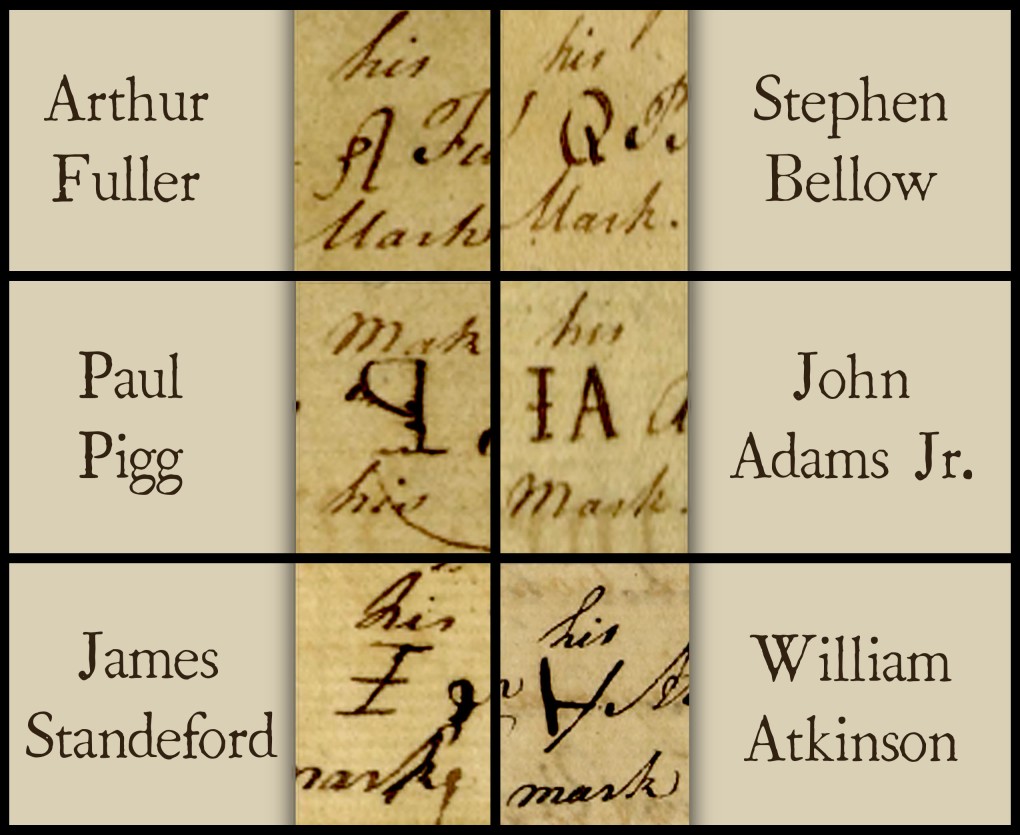
Various marks found in Pittsylvania Deed Book One, 1767 to 1769
The recently rediscovered Pittsylvania County Deed Book One from 1767 is a gem for anyone interested in local history. After browsing over 250 pages, extending into the year 1769, there was one feature that especially stood out among the well-practiced writing of William Tunstall, the county clerk. While the clerk carefully inscribed the legal language of the deed book, the marks and signatures themselves were placed there by some of the earliest county residents. People who could not comfortably write their name were asked to make their mark instead. Today people think of literacy as both reading and writing, but in colonial Virginia they were often taught separately. Growing up, many people learned to read the Bible but never learned penmanship, which required ink, quills, paper, and regular practice. A person who signed with a mark may still have been able to read simple printed text or recognize his or her own name. For some residents, these marks are the only surviving trace of them on paper.
One of the earliest local examples appears on page 16 of the deed book. Under her husband’s signature, Mrs. Mary Wade drew two lines like a plus sign. Crosses and X-shaped marks appear to be the most common choice in the book. Several others incorporated a stylized version of the first letter in their name. Charles Little signed three times on page 25 with “C.” The neatness of his mark suggests he may have been comfortable handling a pen, even if he did not sign with a conventional written signature. The same idea appears in the mark of Thomas Payne (p. 114), who drew a simple “T.” Other common marks were A, E, J, R, S, and W. Several of them contained more character. For example, Paul Pigg (p. 78) drew his letter P backwards, and William Atkinson (p. 146) drew an upside-down “A.” Both were seemingly intentional design choices. William Mullins (p. 140) drew his “W” several ways, all angled at a five o’clock position. Several people chose a circular mark resembling the letter O. In some cases, people chose the mark of a letter that doesn’t represent their name. Stephen Bellow (p. 37) signed with “Q” and William East (p. 116) signed with “A.”
Another recurring mark resembled a Roman numeral I with an additional line through the middle: a crossed-I. Such marks were drawn by Joseph Gorman (p. 34) and James Dyer Jr. (p. 64). A variation of the crossed-I mark by Jeremiah Worsham (p. 32) resembles a double-sided fork with three prongs. There was at least one instance of using two symbols as a mark, especially in the case of John Adams Sr., who marked a crossed-I, and his son John Adams Jr., who wrote “IA” with a crossed-I.
Although most people notice only the flowing handwriting of William Tunstall, the tiny marks scattered throughout the pages tell their own story. The marks represent farmers, wives, tradesmen, and other skilled people who witnessed the founding of Pittsylvania County. They lived in a frontier world, far removed from the advantages of formal schooling available in larger towns. By no means were they lacking in intelligence, as many of them were signing deeds for large tracts containing several hundred acres of land. Perhaps more impressive is the way many of them could transform wild forests into working farms without modern machinery. In comparison, elegant handwriting was of far less importance than providing for large families and communities during the 1760s.