
**This research was first published in the July 16, 2025 edition of the Chatham Star-Tribune newspaper as part of Kyle Griffith’s weekly segment entitled “Heritage Highlights.”
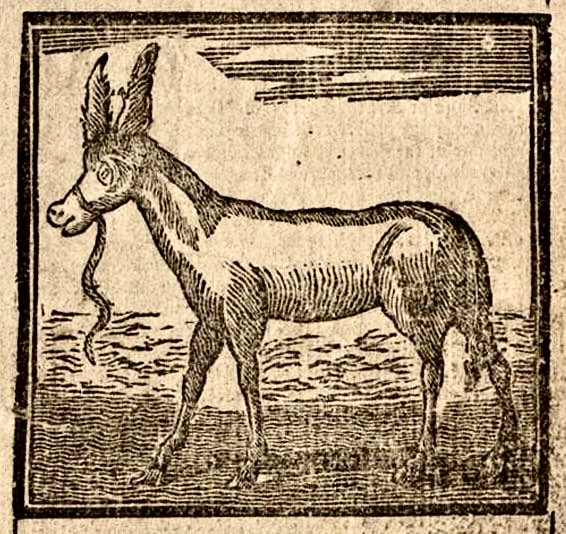
An engraving of Washington’s donkey Royal Gift published in 1786
For many farmhands over the last two centuries, as they cleaved the earth with an old plow, a trusty (or stubborn) mule guided his path over the field. Some of the mules and donkeys used in Pittsylvania County’s history can trace their origin to an individual animal gifted to George Washington by King Carlos III of Spain in 1785. Of course it takes a horse and a donkey to create a mule, but all mules are sterile and cannot further reproduce. The large jack–a breed now known as Zamorano-Leonés–was given the name “Royal Gift” by Washington as he settled into his new pasture along the Potomac at Mount Vernon.
There were actually two donkeys sent by the King, but only one of them survived the trip at sea due to a heavy storm. Washington sent his overseer John Fairfax on a long journey to the port at Boston, Massachusetts to acquire the animals and equipped him with written advice to set out early in the morning, provide everything necessary to prevent neglect of the animals on the road, and “make use of the Stage Waggons–the Stage Coaches are too expensive.” He further warned to “Let the Jacks be put separate & with no other Creatures, lest they should get kicked…& if it is necessary they should be cloathed” in blankets or something suitable. After weeks of travel, Fairfax arrived safe in Virginia, however the donkey was slow to align with Washington’s plans. In a letter to Bushrod Washington, he wrote “If Royal Gift will administer, he shall be at the Service of your Mares, but at present he seems too full of royalty, to have any thing to do with a plebean race.”
Eventually Royal Gift settled in and an advertisement was placed in newspapers across the country in March 1786 by John Fairfax, stating that “Royal Gift is four years old, is between 14.5 and 15 hands high [around 5ft]…he is very bony and stout made, of a dark colour, with light belly and legs.” It further advertised for readers interested in getting a mule to write to Gen. Washington and arrange how they may acquaint the horse and donkey, although “a limited number only will be received from others…” Royal Gift remained at Mount Vernon as Washington reengaged in Constitutional duties and served as the nation’s first president. The donkey lived until 1796, and at the time of Washington’s death three years later his estate inventory listed twenty-seven horses, sixty-three donkeys, and twenty mules in his possession.
Eventually, some of the descendants of Royal Gift were purchased by farmers in Pittsylvania County. An ad was put into the Lynchburg Press (Vol.6, No.2) in 1814 by Col. William H. Clark who owned a mill on Banister River. Clark revealed that a grandson of George Washington’s donkey, similarly named “The Young Royal Gift” lived in the northern section of Pittsylvania County. The ad served the same purpose as Fairfax sent in nearly thirty years prior. The article stated that the donkey “will stand the present season part of his time at Daniel Crider’s on Frying Pan Creek…a part of his time (say about half) at captain Ralph Smith’s, at the Pocket on Staunton River, and one or two days regularly at or near Challise’s Ford, on Staunton, as he passes on from said Crider’s…to be let to mares at the moderate price of Five Dollars the season, to be paid by Christmas, or four dollars if paid at the stable door…Any gentleman engaging and putting five mares will only be charged twenty dollars.” He then dispelled the myth that a mare cannot have normal horse foals again after bearing a mule, insisting this belief is unfounded and “will be contradicted by every gentleman who is acquainted with the subject.”
Clark proceeded to advocate for the use of mules and extended locals the opportunity “of furnishing their farms with those valuable animals.” In addition to helping a farmer save money in keeping the animals and their “superior performance whilst on the Farm, or for the Waggon,” he stated that mules “will last as long as five horses, when the age and liability of the death of a Horse is considered.”
After many generations of keeping draft animals across Virginia and Kentucky, Royal Gift’s legacy lives on in heritage breeds like the American Mammoth Jackstock. It’s intriguing to imagine how many locals took up Col. Clark’s offer. It’s worth wondering where the later generations of that famous donkey ended up–and whether or not, on some quiet farm nearby, his descendants still graze the land.