

**This research was first published in the February 11, 2026 edition of the Chatham Star-Tribune newspaper as part of Kyle Griffith’s weekly segment entitled “Heritage Highlights.”
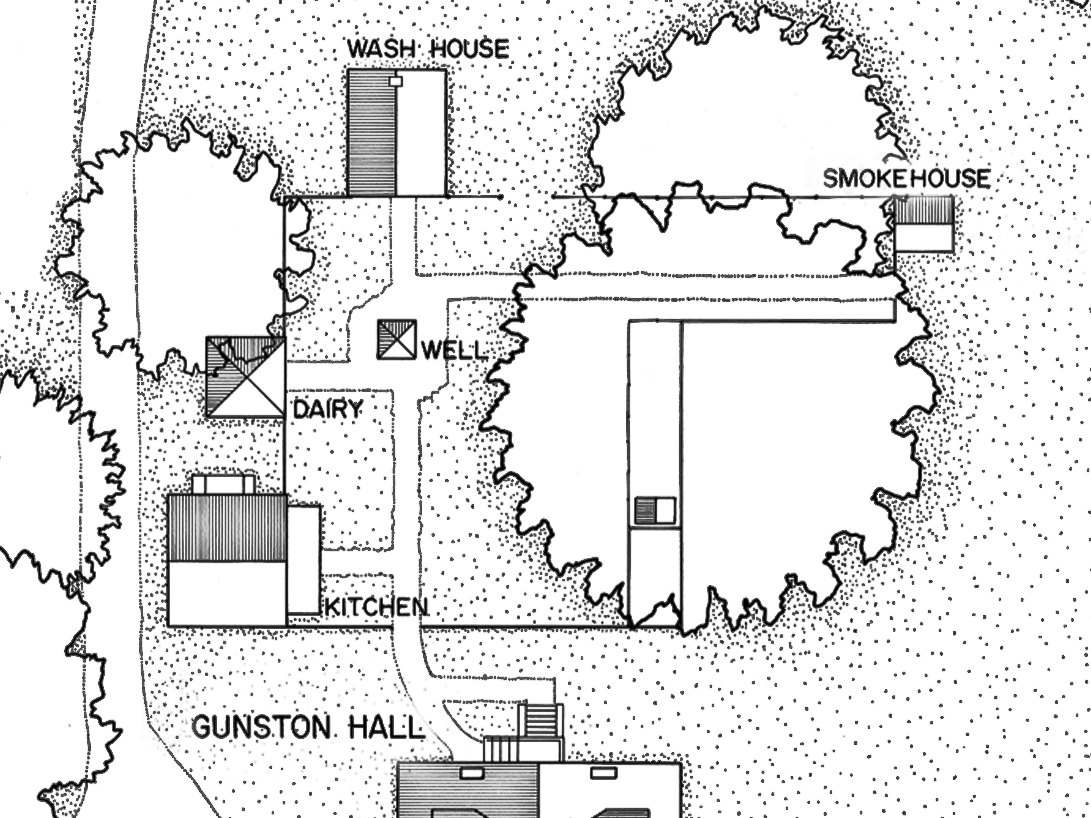
Cropped Site Plan of Kitchen Yard at Gunston Hall
Courtesy of Library of Congress
The most active part of many old farms was not the house at all, but the fenced in yard behind it. The modern fresh cut lawn would have looked strangely empty to farming families two hundred years ago. The absence of grass in many historic yards was not neglect but the result of constant activity. Cooking, drawing water, and completing most daily necessities required a trip through the yard. The working yard supplied the household’s water at the well and functioned as the area for laundry, making soap, bathing, and other heavy chores. The trodden and scarred earth was worn bare, dotted with dark patches where big kettles stood, strewn with wood chips, stones, and the occasional small bone. During hog season, that same corner of the yard turned into a butchery.
For homesteads that featured a kitchen as a separate building, the kitchen yard became a whole concept in itself. Early nineteenth century mutual assurance policy maps show that several properties in Fredericksburg, Virginia had kitchen buildings situated about forty feet away from the main dwelling. The separation was, of course, for the safety of the main house in case of an unruly fire, and to keep the overall temperature of the home down in summer months. A few mid-nineteenth century homes in Pittsylvania County had kitchen buildings between sixty and one hundred feet from the house. On more formal and expansive rural properties, the kitchen door opened into a fenced area defined by small outbuildings or dependencies situated at the corners and edges of the yard. Smoke, steam, and the sound of boiling water were daily features of the space. A clear example is seen in Fairfax County at Gunston Hall, the eighteenth century residence of Founding Father George Mason. A short path leading out from the main house entered a gated area containing the well house in the center. Along the fence line stood the kitchen, the dairy, and the wash house.
A site plan of Green Hill in Campbell County shows a complex system of buildings that very few could match in scale, but is valuable as a nearly complete picture of a rural landscape with all of its amenities and natural resources being put to use. Around 1800, Samuel Pannill had his imposing Federal Style home built overlooking the Staunton River. When facing the front of the home, an area off to the right side served as a kitchen yard that was lined with chicken houses just behind it. The consistent use of the path between the kitchen and home called for a cobblestone walkway to be laid down. In addition to previously named outbuildings, Green Hill featured an ice house, beehives, duck house, and a so-called factory for spinning and weaving fabrics. Other wealthy landowners commissioned large stone tubs and stone tables to be carved for their kitchen yard.
For more manageable farms that don’t have dozens of buildings and could be operated by one family, some of the yard dependencies served multiple functions. Many old homes did not lose their outbuildings all at once, but slowly lost the reliance on the working yard as the heart of the homestead. Plumbing replaced the well house, machinery replaced the wash house, and refrigeration replaced the dairy and smokehouse. Aerial photos from the 1960s show small farmhouses that contained little villages of sheds, cribs, and other dependencies bounded by a fence to create the working yard. Eventually new homes had no need for accompanying buildings in the yard other than the occasional storage shed. Across Pittsylvania County, lone and dilapidated structures remain like small puzzle pieces hinting at the lost yard enclosures that once kept families alive. The modern backyard has become a place to relax rather than a necessary avenue between the compartments of daily life.