
**This research was first published in the December 31, 2025 edition of the Chatham Star-Tribune newspaper as part of Kyle Griffith’s weekly segment entitled “Heritage Highlights.”
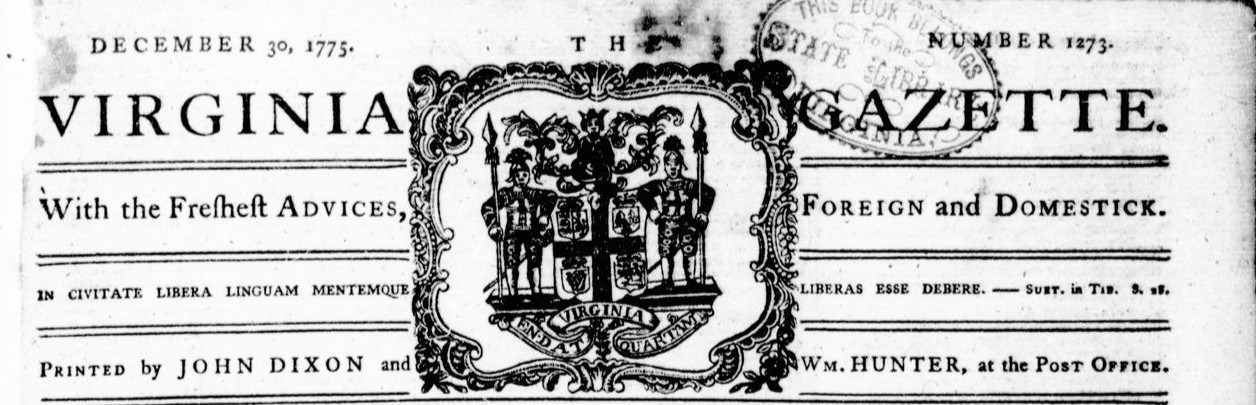
The Virginia Gazette masthead from December 1775, with a British royal style illustration
In sight of the upcoming New Year, one might wonder what historic events and chapters will unfold throughout the coming 2026. The 250th anniversary of the Declaration of Independence will arrive, which stirred up a thought: what were residents of Virginia anticipating back in December of 1775? Just a few months beforehand, King George III had issued a proclamation that declared the American colonies to be in a state of rebellion against Great Britain. Old newspapers frame a few of the priorities and qualms of the time.
On the front page of the Virginia Gazette (Pinkney: Dec. 30, 1775 – pg. 1), a defensive response from the Continental Congress was published from earlier that month. Congress went to great lengths to explain how they were not rebellious against the King, but were against letting British lawmakers in Parliament attempt to control the American colonies. “We are accused of ‘forgetting the allegiance which we owe to the power that has protected and sustained us.’” they quoted from the King. “What allegiance is it that we forget? Allegiance to Parliament? We never owed it, we never owned it.” They insisted on their continued loyalty, claiming “Allegiance to our King! Our words have ever avowed it, our conduct has ever been consistent with it.” These were not the words of people who yet anticipated independence. The main talk of war concerned Canada as General Montgomery advanced toward Quebec, and was killed in battle the next day.
Congress argued that the word rebellion was “a term undefined and unknown in the law.” They believed that obeying lawful duty did not require surrendering rights, and resistance could be constitutional rather than rebellious. “We have been compelled to arm ourselves in defence of our liberties.” Virginia citizens read that Congress had not raised armies “with ambitious designs of separating from Great Britain” and that they promised to lay down arms if the legislative hostilities would end. From this last major newspaper published in 1775, tensions between powers are clear, but to many, 1776 arrived as a mundane year before it broke into Revolution. Of further interest, the newspaper advertised the sale at the printing office of “a large and exact view of the late Battle at Charlestown, elegantly coloured, price one dollar.” The battle was later called the Battle of Bunker Hill, and the artwork would have been the only way for someone to see a visual depiction of the event.
Despite the war of pen and ink between Williamsburg and the King, winter chores still needed completing for the common Virginia family. Fires needed tending, livestock feeding, and planning for the next year’s crops. Another publisher of the Virginia Gazette (Dixon and Hunter) continued announcing new shipments of goods in stores, lands were still being sold, debts were still owed, and strayed horses still required searching for. One merchant coincidentally shared the name of Pittsylvania County’s namesake, William Pitt, but it would seem that he was not the same individual as the famous British statesmen. His goods, however, seemed to be quality British imports. He had just received a shipment of fabrics, silks, wools, cottons, and more specific blends and textures such as dorseteens, durants, velverets, floridas, bombazeens, and satin cardinals to name a few. Other imports included rappee snuff, coffee chests, hour glasses, tools, furniture, garden seeds, China, brassware, and much more. Within a few months, the trade that supplied similar stores were strained, redirected, or lost altogether.
As the 250th anniversary of 1776 approaches, Virginians will have special opportunities to engage with the history of the era through initiatives such as the Virginia 250 passport. The commemorative booklet includes seventy museums across the state, including the Danville Museum of Fine Arts & History, that will stamp the passport and allow a 15% discount on admission at the sites featured inside. The passports are available for free at certain museums across the state including the Virginia Museum of History & Culture, Colonial Williamsburg, Jamestown-Yorktown Foundation, Monticello, Mount Vernon, and at twelve Virginia Welcome Centers. The coming year will be full of other special living history events, reenactments, academic presentations, and market fairs celebrating the “semi-quincentennial” or a quarter millennium since the founding of the United States. There are very passionate and knowledgeable historical interpreters out there, more accurate and well-researched than ever, who will be glad to help make history come alive.
Click here to visit virginiahistory.org and read more about the Virginia 250 Passport.