

**This research was first published in the October 15, 2025 edition of the Chatham Star-Tribune newspaper as part of Kyle Griffith’s weekly segment entitled “Heritage Highlights.”
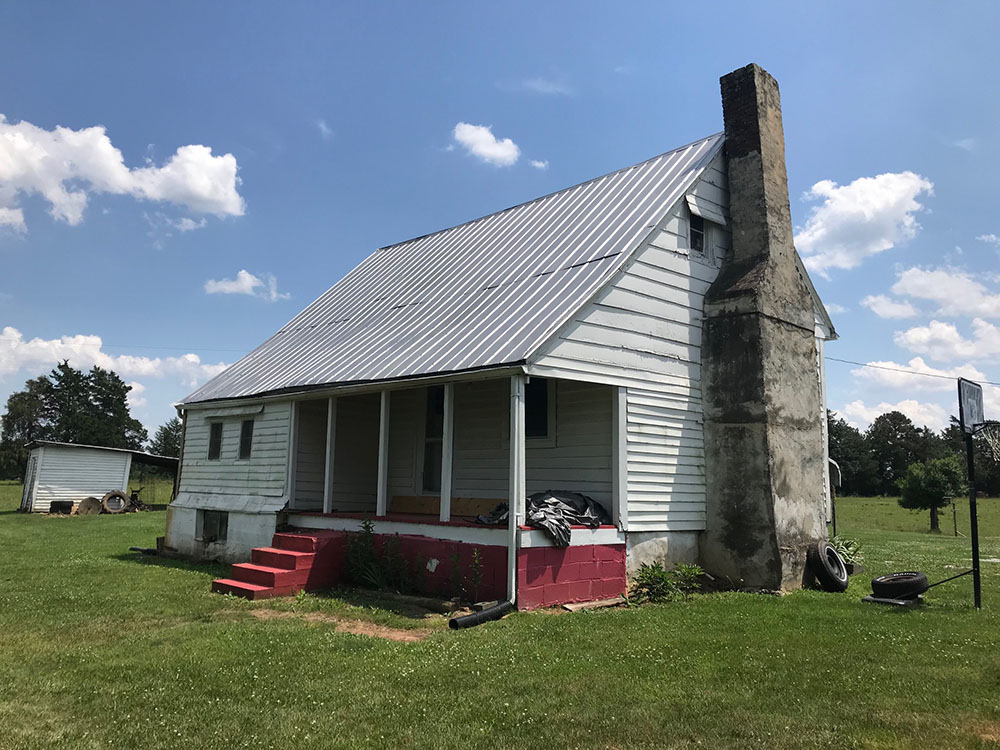
Formerly Brown’s Tavern, Photo by Kyle Griffith, 2019
Imagine traveling through Pittsylvania County about two hundred years ago from the Dan River to the Staunton River, riding only a few miles per hour by horse. It would likely take around two full days to traverse the county, and therefore taverns were the journeyman’s rest stop for meals and lodging between travels. Locals know about Yates Tavern near Gretna, but about seven miles by road to the east, near Stinking River, another tavern operated during the 1840s called Brown’s Tavern.
The story of the tavern begins with the life of John E. Brown (born around 1783), of Halifax County. In 1804 he married Miss Mildred Dismukes, who was around his age, and together they raised at least seven children. In 1813 they purchased land in Pittsylvania County near Chalk Level close to Greenfield Church and the vast landholdings of Thomas Mustain’s heirs. John and Mildred’s daughter Elizabeth married Richard Whitehead Jr. (born 1807) who had many notable descendants, some of whom include Judge Langhorne Jones Sr. and Giles Vaden III of Galveston Mill.
After John’s death in 1843, the homeplace passed to his wife Mildred, and their son John Richard Brown remained with her. As a widow, Mildred Brown took charge of the property and opened the home as a tavern to help support herself. Most of her children had moved west by that time and had their own families. In the event that her son John did not also pass away in 1845, it is likely that he would have inherited the property and possibly continued the operation of his mother’s tavern. However, the business appears to have closed by 1850.
The 1850 census listed Mildred in her sixties as the owner of 317 acres. A young laborer, Edward Adkerson, was hired to farm the land. That year’s agricultural census provides a detailed view of the farm’s efforts: 2,800 pounds of tobacco, 500 bushels of flint corn, 180 bushels of wheat, 5 bushels of Irish potatoes, twenty bushels of sweet potatoes, and ten pounds of flax were produced. Livestock included two horses, two work oxen, six other cattle, twenty swine, and twenty sheep, all worth $150. They produced thirty pounds of wool and churned a hundred pounds of butter. Mildred lived adjacent to a miller named John Nichols as well as another property with overseer Lorenzo Shelton and constable William H. Mustain.
The nearby Monroe-Tate Cemetery features an impressive stone wall surrounding the graves of the Brown family and their relatives. The collection of mid-nineteenth century stones are all hand-carved and contain many elements of character. Mildred Brown, “consort of John E. Brown,” lived to be around seventy-two years old and was buried in 1858. One of the oldest stones from 1832 was inscribed for Mildred’s son, Lock Brown, who “was bornd” in 1806.
A 1936 report by the Works Progress Administration recorded the structure’s use as a tavern and the building’s features are in line with the time period John and Mildred moved to Pittsylvania County. An architectural survey from the following year recorded Brown’s Tavern as a two-story structure with eight rooms and a three-room basement. The kitchen and dining room were located in the stone-walled cellar. Ceilings reached ten feet tall, and sixteen windows once lit the interior, though some had been covered or removed. Photographs from the 1930s show a large front chimney and evidence of porches, since lost.
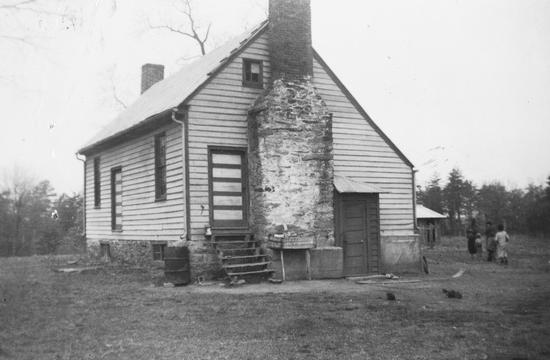
Formerly Brown’s Tavern, View to the Northwest. Photo courtesy of the WPA, 1937.
Please note that the old Brown’s Tavern is on private property and this is not an invitation to visit without permission. In 2019, members of the Pittsylvania County Historical Society including myself visited the site with the owner’s permission and got to go inside. Modern alterations include a cinderblock porch and a metal roof, but some of the original stones are still visible in the foundation and the remaining chimney structures. This historic site deserves to be preserved and possibly restored to retain more accurate historical materials. It’s a gem that helps better understand the sort of similar structures that have since been lost from other parts of the county.