
**This research was first published in the September 24, 2025 edition of the Chatham Star-Tribune newspaper as part of Kyle Griffith’s weekly segment entitled “Heritage Highlights.”
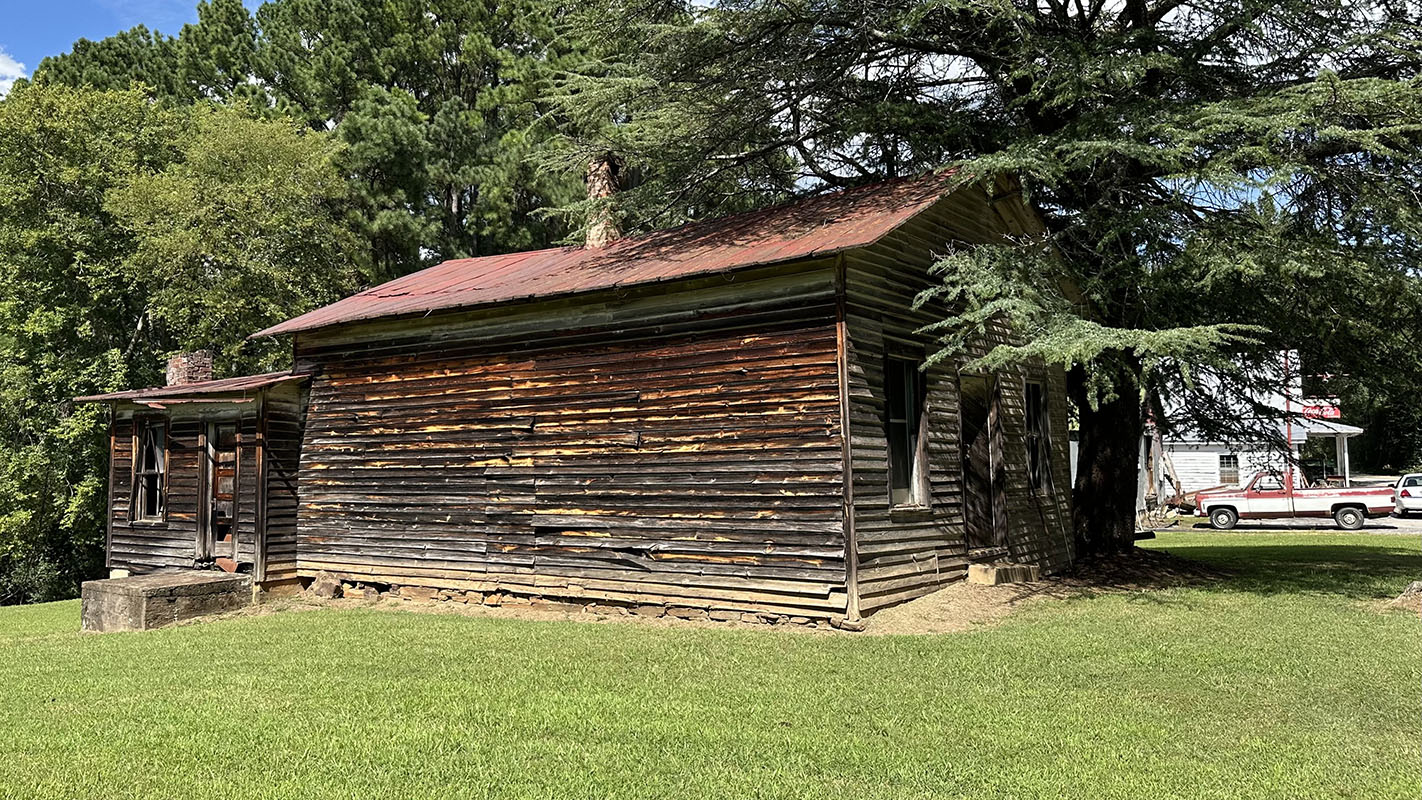
On Riceville Road, the former office of Dr. J.W. Price, later the Ferd Brown home.
In continuation of learning the roadside history of Route 640 in Pittsylvania County, last week’s article ended at the intersection of Elkhorn Road. To preface this description of the Riceville community, it has a long and complex history that is deserving of more research and documentation. There are lifetimes of stories to tell about each home and business, and the remaining buildings help piece together a general idea of life generations ago.
At the intersection of Java Road and Yeatts Store Road, one of the old Rosenwald Schools constructed for African-American students in 1925 still stands. The Lipford School, which had two teachers, was constructed on a concrete foundation as a one-and-a-half story frame building with a metal roof. Lessons took place by the light of oil lamps and the heat of a wood stove. After the school closed, it was converted into a private residence and its appearance has changed. Gray asphalt siding now covers the walls, the metal roof remains red, and the large classroom windows have all been replaced with smaller windows in fewer locations.
Further north, shortly past the 640 Community Rescue Squad on the east side of the road, set back near the tree line is the old two-story Riceville School. At one time there were a handful of schools just like this one in the county and it has remained relatively unchanged over time. A surviving photo from around 1929 showed that there was another doorway above the front entrance with a transom window above. There were also four small square windows in the projecting dormer in the roof which have since been covered by siding.
Less than half a mile farther north, near the center of Riceville, the west side of the road is lined with old country homes and stores. Much like in the Java community, the Adams family operated a store here known as the Adams & Adams Store. Census records show that Charles F. Adams served as the primary merchant through the 1940s. Many locals also remember his first cousin, Edsel Adams, who later managed the store. Edsel’s uncle Burton D. Adams was the postmaster of Java and another of his uncles named Raymond worked as a local mail carrier. After Edsel’s passing in 1985, his wife Clara remained a familiar face there for many years.
A few dozen yards to the west of the store is an eye-catching old building with sun-scorched walls, a red metal roof, an interesting diagonal-plank double door, and a shade tree looming over the roof like an umbrella. This is thought to have been the office of Dr. John W. Price, who served the community during the 1880s and 1890s. It probably had several uses over time, probably as a store as well. As of 1950, it was used as a residence by Ferd Brown who worked as a trucker at that time. Next to Ferd lived a blacksmith named Henry Guthrie from Halifax County and his wife Hallie who was listed as a “retail salesladie.” Of further note, a sawmiller named Thomas F. Cooper lived next to the Guthries and had their operations nearby.
Further north to the intersection of McDaniel Road, another old store occupies the bend of the road. Census records show that between 1930 and 1950 the store was run by Meads C. Irby (born in 1882) and his wife, former Miss Lizzie F. Rogers, who was listed as a sales lady. By 1940 they had installed a gasoline filling station, for which Meads hired a man named Raymond W. Layne to attend. Following Irby’s passing in 1962, his daughter Elizabeth continued the family business for over forty years under the name of Emerson Grocery Store with her husband Leonard Emerson.
Finally, as the road meets the fork with Corner Road, Riceville First Baptist Church faces a pair of old farmhouses. The one on the right of which has served the community as a masonic lodge. The sign out front states that Polk Lodge No. 61 was chartered in 1850, shortly after the presidency of James Polk. Out back, a reminder of old-fashioned practicality still stands: a Johnny house, now fitted with a lightbulb for the comfort of modern visitors.
Pingback: Java to Elkhorn – Roadside History – Griffith Preservation