

**This research was first published in the August 20, 2025 edition of the Chatham Star-Tribune newspaper as part of Kyle Griffith’s weekly segment entitled “Heritage Highlights.”
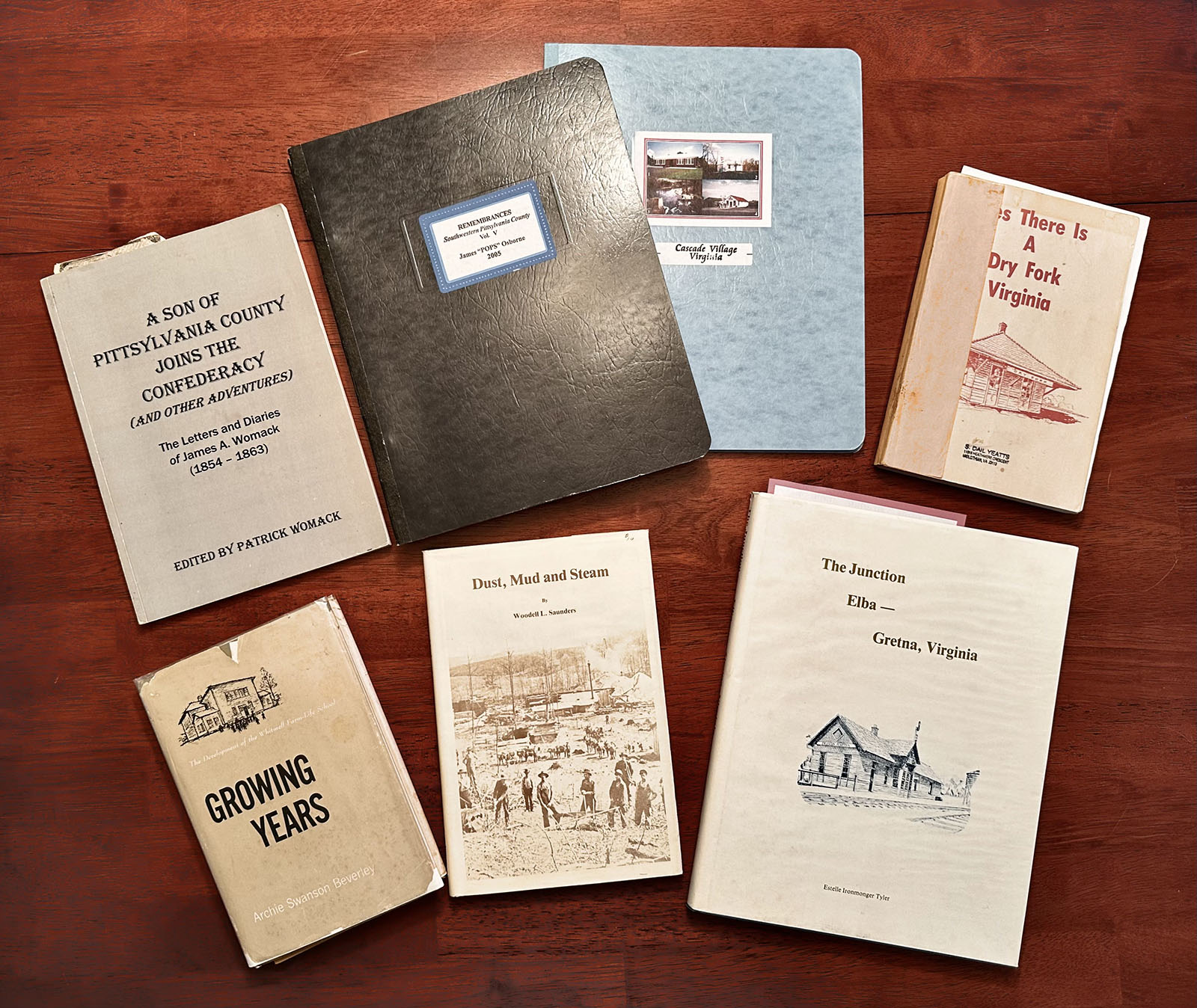
The covers of seven titles highlighted in the article
As a county, Pittsylvania is lucky to have such a long list of dedicated historians, story collectors, and other authors passionate about preserving the memories of life in southern Virginia. “The History of Pittsylvania County” (1929) by Maud Carter Clement remains the paramount resource for researchers, in addition to the works of Frances Hallam Hurt, Herman Melton, and Dr. Larry G. Aaron, whose essential books are still available through the Pittsylvania Historical Society. However, there are many obscure titles that are out of print, but sometimes they will surface among certain bookstores or collections, so keep an eye out within local businesses to see if another becomes available.
James “Pops” Osborne published a collection called “Remembrances” (1999-2005) within five volumes. He also published “Cascade Village, Virginia” (2005) about that historic community west of Danville. The six books are filled with photocopied pictures, old documents, and handwritten personal memories collected throughout his life. In each book, Pops covered a different portion of the county, starting with the northern section and moving around to the southwestern section by the fifth volume. The books have simple black or blue covers and are bound together with metal pronged fasteners, therefore they don’t have a title on the spine and may be difficult to spot on a shelf. Thankfully, however, they are more common to find than one would expect. For those who can’t find a copy, I recommend stopping by Maynard Amos Grocery (a country store from the 1890s in the Worlds community) buying a snack, and asking and owner Mrs. Reynolds to look at the copies on her shelf (not for sale).
To untangle some of our complicated railroad history, “The Junction – Elba – Gretna, Virginia” (1990) by Estelle Ironmonger Tyler covered the town’s different eras, pinpointed its earliest landowners such as the Ward and Talbot families, and analyzed a bit into every crevice of the town’s inner workings and notable businesses over time, packed with plenty of historical images.
“Dust, Mud and Steam” by Woodell L. Saunders (1980) highlights the more rugged and sometimes vulgar sides of life his family experienced as lifelong sawmill operators traveling around during the early twentieth century. The book outlined the legacy of four generations of Saunders men, their extensive workforce, and the stories that led to the formation of Saunders Lumber Company at Whittle’s Depot, which altogether closed in the early 2000s.
Residents near the areas between Chalk Level and Shockoe may especially find interest in Patrick Womack’s 2015 title “A Son of Pittsylvania County Joins the Confederacy (and Other Adventures). Descendants of Allen Womack ran a mill there near the mouth of Whitethorn Creek from Banister River during the early 1800s. The book serves as a collection of transcribed letters and primary resources that reveal rare details of business and local country life over 160 years ago, not wholly focused around the wartime.
“Growing Years” (1955) by Archie Swanson Beverley, longtime principal at Whitmell School. The reader does not need any connection to the school in order to appreciate this book, as it can be applied as a history of rural education. The path of Whitmell’s story outlined the quintessential milestones desired to be reached by many other little country schools throughout the U.S. Mrs. Beverley’s It gives a better understanding of the Farm-Life school program especially during the 1910s and 1920s.
“Yes There Is A Dry Fork, Virginia” (1977) by Charles B. Motley is quite an obscure title, but it holds many interesting memories and stories of legend that reach outside the limits of the Dry Fork community to Whitmell, Swansonville, and Danville. The book is typewritten with many leads on genealogy research, local schools, and church records. Some copies are spiral bound and will appear like a cook book with no title on the spine.
There are plenty more books to add in the list, but the abovementioned titles contain real gems of knowledge and imagery that should be appreciated by more people. Each one helps to better understand the way life was for the abundance of rural families who occupied the county long ago.