

**This research was first published in the July 2, 2025 edition of the Chatham Star-Tribune newspaper as part of Kyle Griffith’s weekly segment entitled “Heritage Highlights.”
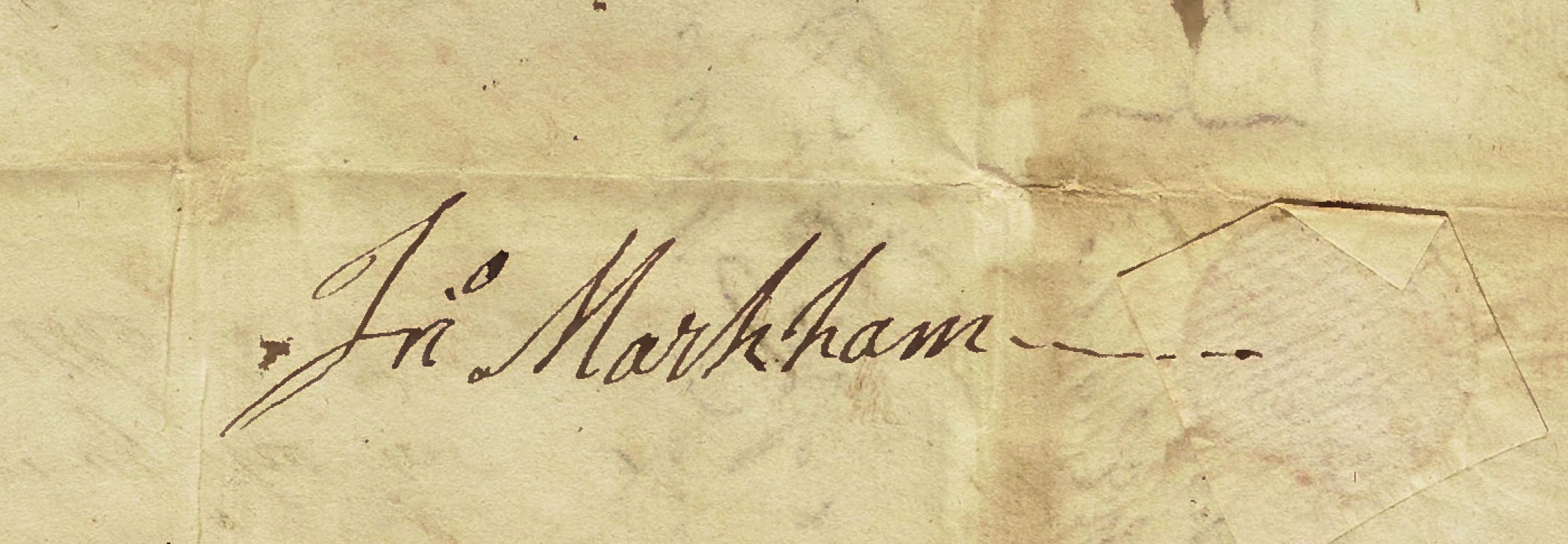
Signature of John Markham on a document from 1797
As the crow flies, about nine and a half miles northwest of Chatham, a quiet community called Markham retains a long and interesting history concerning those who settled there. Located in a bend along the Banister River, the land proved to be a desirable spot near the mouths of Shockoe Creek, Whitethorn Creek, and Georges Creek. Before it was affiliated with the Markham family, it was the plantation of Col. John Donelson and, before him, the local Native Americans constructed weirs in the river which acted as stone dams for fishing.
Col. Donelson acquired a large tract of land, including modern-day Markham during the 1740s. As an officer in the local militia, a vestryman, surveyor, and burgess, his name was revered during the formation of Pittsylvania County. However, after hearing tales of the frontier territory south of the Ohio River, he moved to modern-day Tennessee. In 1779 he set out westward with a party of relatives including son-in-law Capt. Thomas Hutchings, brother-in-law Hugh Henry (uncle of Patrick Henry), and daughter Rachel Donelson (who later married Andrew Jackson). In Pittsylvania County, Donelson sold his plantation property to John Markham, namesake of the current community. Markham is an ancestor of the article’s author, Kyle Griffith, and probably many others in the county.
While there are a few certainties about the life of John Markham, there are also many gaps in his life where little can be found. Records concerning his father were taken in Chesterfield County as early as 1752. After a few years leading his local county militia, Markham also served during the early days of the American Revolution. His name was included on a muster roll of the 8th Virginia Regiment from 1777. Colonel Abraham Bowman led the group followed by Lieutenant Colonel John Markham, then Major William Dark, and nine others. After a loss at the Battle of Germantown in Pennsylvania later that year, Markham’s service came to an end and he returned to Virginia.
Stories of fertile lands around Pittsylvania County must have passed through Chesterfield County. Markham moved down to the rapidly expanding backcountry and found a worthy lady to be his wife. Genealogists still desire to find a document that states her maiden name, but several records hint toward the theory that she was Mary Tunstall (possibly a niece to the county’s first clerk, William Tunstall). Markham later appeared as an executor to the will of Thomas Tunstall and was involved in several land transactions between the family. Deed book records show that John Markham was paid to build “a prison, stocks, and pillory for use of Pittsylvania [county], near the meeting house spring.”
In 1779 John Markham purchased Col. Donelson’s former dwelling house and about a thousand acres for £2,800. In today’s currency, that value would be around $600,000, which was probably also affected by wartime inflation. A plat map drawn in 1799 shows that John Markham owned an additional 476 acres along the middle fork of Stinking River to the north. There he shared a boundary line to the south with Leonard Dove, a brother to William Dove who owned a grist mill nearby. Markham and his wife raised a large family and his descendants married into the nearby families, including the Whitehead and Dove families. Markham also served as a founding officer of Pittsylvania Lodge No. 24, being the first junior warden of that masonic lodge when it was organized in 1788.
John Markham lived into his sixties and passed away in 1801. His inventory taken after his passing revealed that he owned about nineteen heads of cattle (including calves), and a yoke of oxen. He had two big hogs, a sow with pigs, and one sorrel horse. His widow acquired the house and about three hundred acres of land around it. Her own inventory taken after her passing in 1809 showed that she introduced twenty-one geese, fourteen turkeys, twenty more hogs, and a “mudd colt” to the farm. Over the following two centuries, the land has been subdivided into smaller farms and remains a bucolic tract along the riverside.