

**This research was first published in the September 3, 2025 edition of the Chatham Star-Tribune newspaper as part of Kyle Griffith’s weekly segment entitled “Heritage Highlights.”
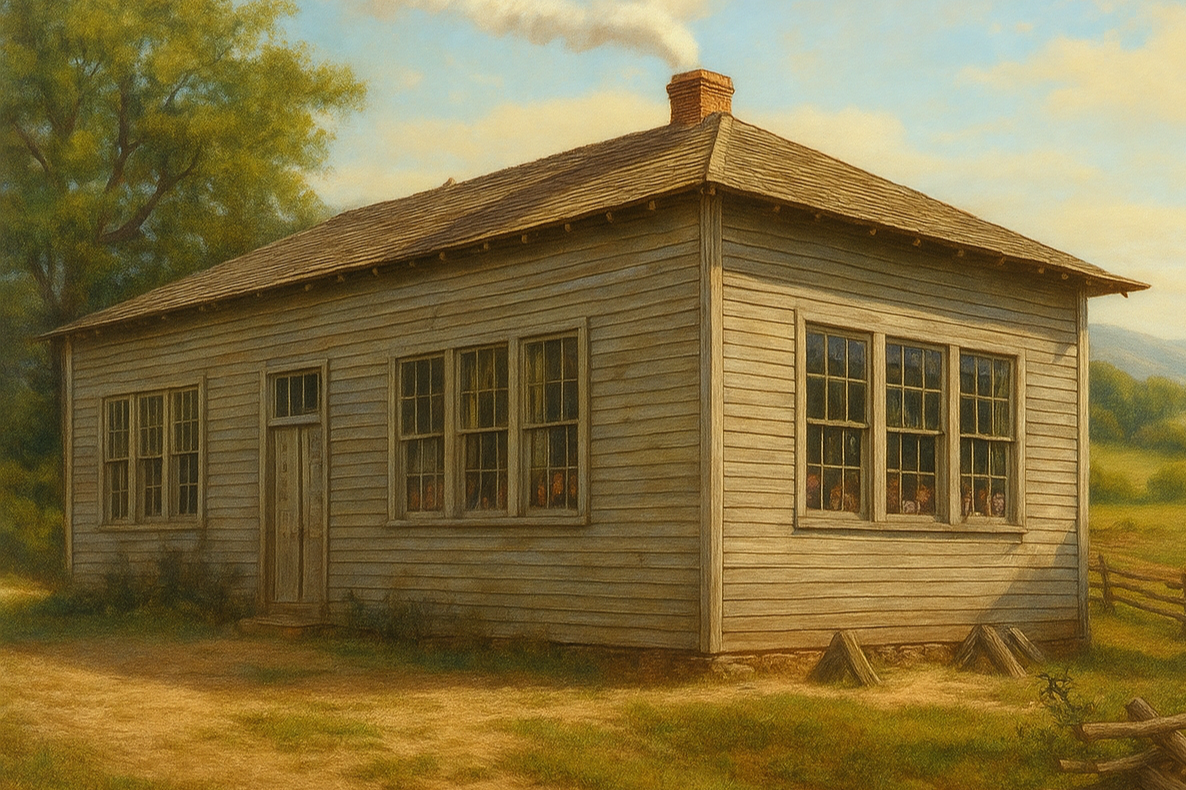
A conceptual rendition of a typical two-room rural school based on a
1920’s photo of Piedmont School in Dry Fork, reimagined using Sora AI.
About a century ago, the School Buildings Service of the Virginia Department of Education compiled a collection of photographs from a survey of state-operated elementary and secondary schools. On the Library of Virginia’s website there is a catalog with over 200 scans of schoolhouse photos dating from the 1920s and into the 1940s available to view online. Unfortunately there is not much information to accompany each photo other than the name (some are incorrectly spelled) and a terse description of the type of school or the district it was in. As for the exact locations of each school, the time periods they operated, the population of teachers, students, etc., all will require further research. However, the photographs contain enough visual information about the architectural styles of schools within Pittsylvania County about one hundred years ago to make some interesting observations.
Generally, by the mid-1920s, students in Pittsylvania’s rural communities attended relatively small buildings with classmates of varying ages and grade levels. School size ranged from modest, one-room structures to broader, two-story buildings with four or more classrooms. The more modern frame schools of the time were typically balloon-framed, with sturdy brick chimneys, numerous tall sash windows, and new metal roofing.
Since the photos in the survey were taken around four decades before the desegregation of schools, the disparities between all-white schools and all-black schools are apparent. Families and churches in black communities had to produce their own money and labor to build schools without the aid of government funding. The most rudimentary schools resembled those traditionally built during the 1700s and early 1800s. Several log schoolhouses were still in use around 100 years ago, which were typically built as a community effort from nearby timber, hewn with old broad axes, notched together, and daubed with clay. Instead of a fireplace, a small wood stove radiated heat from in the middle of the classroom with a long flue pipe sticking out through the center of the roof. Log-constructed schools in the collection include Beaver’s, Dry Fork, Kentuck, Mountain, Piney Level, Pounds, and Sunny Level.
There were many other small single-room schools built with balloon framing instead of logs, typically with gable-side entrances. It was also common to either paint the frame schools a light color with a dark toned trim around the doors, windows, and corners, or vice-versa. Little frame schools were identified as Axton, Carter’s, Clifton (near Toshes), Cook, Lindsay, Mt. Freemon, Oak Grove, Walton, and Whitethorn. There were also many two-room frame schools, some of which included Banister, Crews (which stood about a mile east of Tightsqueeze), Forest, Hollywood, Markham, Mt. Airy, Piedmont (in Dry Fork), Pocket, Reynolds, Swansonville, Sycamore, and Triangle.
A step up in scale were several large, cubic-shaped schools with two classrooms per floor and sometimes a small second-story balcony over the front entrance. Examples in the survey include Climax, Davis (near Whittles Depot), Riceville (still standing), Rock Spring, and Unity (which stood on Mount Cross Road south of Hinesville). An even larger school called Astor was built with a tall, fully exposed brick basement that functioned as a usable first floor. Callands High School was massive by rural standards in comparison to the others previously listed in that it was two separate buildings. From the exterior it appears to have held at least eight large rooms in each building, featuring twenty windows on the sunny side of a school building, and a cupola bell tower on the corner of the roof. In a similar sort of arrangement, Whitmell had recently enlarged their school into two large frame buildings with tall brick chimneys and dozens of windows. As a Farm-Life school, it grew at a quick pace during the 1920s and gained many specialty classes that weren’t found in the other rural schools in Pittsylvania County.
Even though most of the old rural schools have vanished from the landscape, their shadows linger, and the absence of information only sharpens the need to preserve what fragments remain of their history. Between old photographs, historical maps, written histories, and the memories of our current generations, there is still time to piece together a fuller history of the county schools that once shaped Pittsylvania’s rural communities.