

**This research was first published in the February 18, 2026 edition of the Chatham Star-Tribune newspaper as part of Kyle Griffith’s weekly segment entitled “Heritage Highlights.”
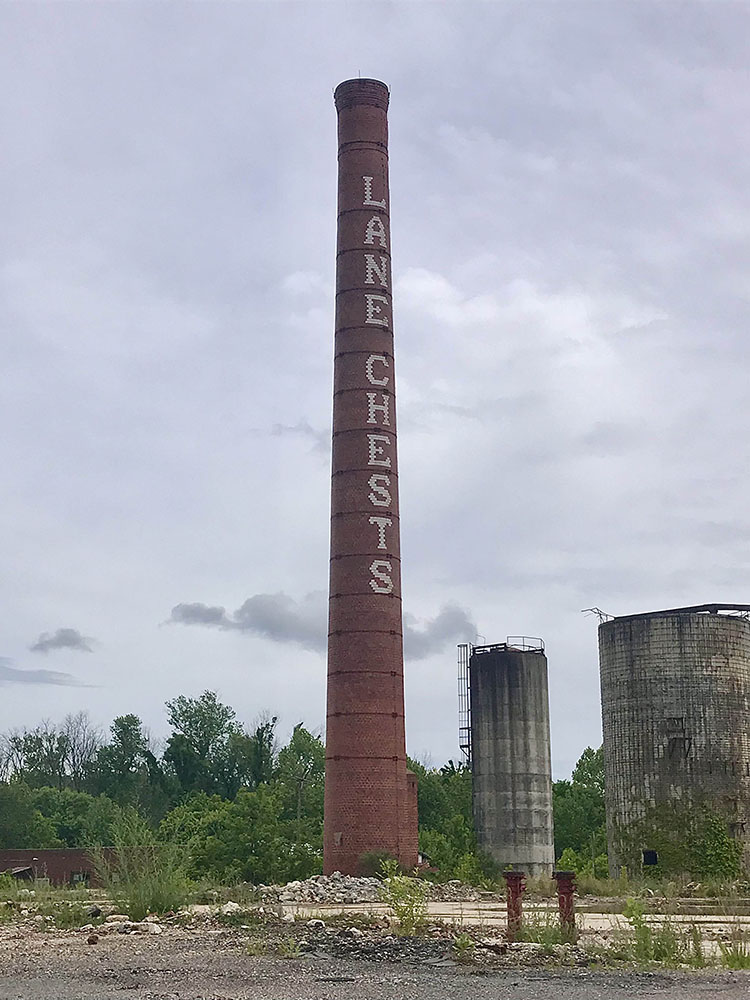
The “Lane Chests” smokestack in Altavista was constructed in 1926.
Photo by Kyle Griffith in 2019
Almost anywhere in the United States, furniture collectors will be familiar with Lane Cedar Chests. Millions of red cedar chests furnished homes far and wide during the height of the company’s success. Edward Hudson Lane established the first factory at the railroad in the Town of Altavista, Virginia in 1912. Since it closed in 2001, the former site has been rusting over as nature reclaims the parking lots and structures. An impressive brick smokestack remains as a monument to Lane’s legacy. As of this writing in early February 2026, the smokestack will turn one hundred years old this month. One story from the Altavista Journal was published on February 11, 1926 and provided the following details:
“The smoke stack that is being constructed by the Rust Engineering Company, of Washington, D. C., is nearing completion. The stack is one hundred and fifty feet in height and at the top is seven and one-half feet in diameter, while at the base it is eleven feet in diameter, on the inside. The big chimney is constructed of hard burned red radial brick with the words ‘Lane Chests’ in a vertical line on the side of the chimney facing the Virginian Railway. The outside of the stack has been completed as well as the lining. By the last of this week all of the work on it will be completed including putting the lightning rods up if the weather permits.” If the plan went as expected, the official one hundredth anniversary should be on either February 13th or 14th, 2026.
The same paper detailed several other updates underway for the company, including: “several alterations being made in the boiler house, which are the firing of the boilers from hand fire to that of automatic stokers. The object in view is to burn the wood waste to better advantage. The boilers will be connected to the smoke stack by steel flue which has already been shipped and will be installed immediately on arrival…This work is being done by C. W. Hancock and Sons of Lynchburg.”
An advertisement from the Virginian-Pilot and the Norfolk Landmark from November 22, 1925 advertised over sixty styles of Lane Chests available for as low as $7.85, which had around the same buying power as $140 in modern times. The most expensive was listed at $53.75, which was the same as spending a bit more than $950 for a quality chest today. An edition of a Richmond newspaper called The News Leader from May 1, 1924 contained an advertisement for the best selling sizes of cedar chest at that time. Keep in mind that their dollar was equivalent to about twenty dollars now. 33-inch Lane Chests sold for $14.75, the 40-inch chests sold for $18.30, and the 48-inch sold for $33.45. As a rule of thumb, Lane Chests older than the 1930s usually have a six digit serial number that reveals the date of manufacture. Newer chests have a seventh digit to identify the plant of origin, and the serial number must be read backwards. For example, 6410102 written backwards and omitting the seventh digit translates to 01/01/46 or January 1, 1946.
The historic census records taken in Altavista reveal that many people in the community were employed by the cedar plant. In 1930, some of the specific jobs were described vaguely as “laborer,” but there are quite a selection of departments named. Nearly every census page lists Altavista residents who worked for The Lane Company as either a draftsman, engineer, machinist, feeder, glue spreader, clamper, trimmer, sander, sprayer, polisher, painter, or an inspector. A few last notable jobs included sawing, filing the saws, typing (documents), hinging chests, veneering, and finishing. The long list still doesn’t represent the various levels of managers and selling agents throughout the town. At that time they produced at least 250 cedar chests per day.
In recognition of the historic Lane Chests smokestack turning one hundred years old, the previously mentioned primary resources help create an idea of the setting up to that point. The business reached much higher levels of success during the 1940s and 1970s, with nine factories and thousands of employees across Virginia, North Carolina, Tennessee, and Mississippi. The old advertisements that claim the chests will last for generations still hold up to be true.