

**This research was first published in the August 6, 2025 edition of the Chatham Star-Tribune newspaper as part of Kyle Griffith’s weekly segment entitled “Heritage Highlights.”
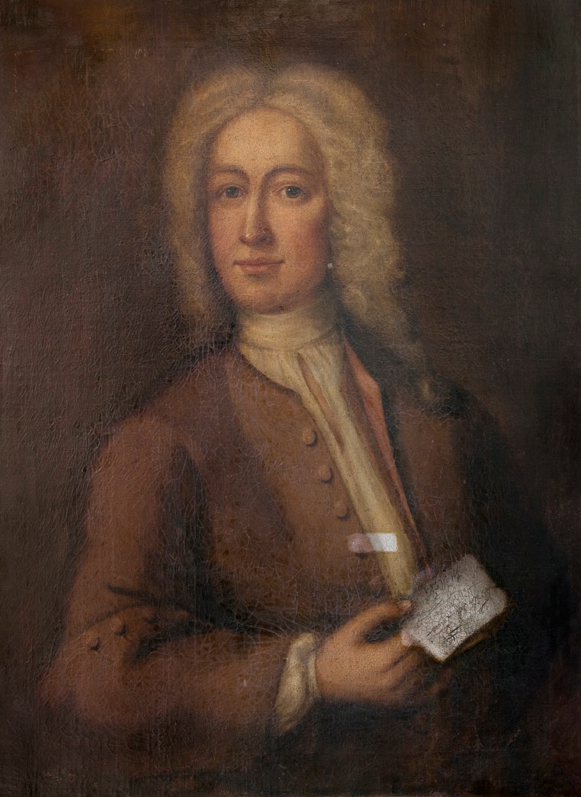
A possible painting of John Lawson by Godfrey Kneller circa 1709
In 1700, English explorer John Lawson began a thousand-mile journey through frontier Carolina, before the separation of the colony into North and South Carolina. Many of the native tribes he encountered soon migrated north and merged with the tribes of Virginia as European settlement expanded westward. Near the end of his journey he passed by several sites that are about an hour’s drive south of Pittsylvania County, Virginia, which are detailed in the following excerpts from his journal.
On February 5, 1701, Lawson and his crew arrived and lodged for several days at Keyauwee Town, which was south of modern-day High Point, N.C. along Caraway Creek. Its location was naturally fortified by the mountains and allowed the Native settlers to graze about 100 cattle nearby. “We being six in Company, divided ourselves into Two Parties…” Lawson stayed in the home of the chief, “Keyauwees-Jack,” and the others stayed in a house nearby. They were surprised to see the native men there kept mustaches whereas most plucked their facial hairs “up by the Roots, and suffer none to grow.” Several men from Lawson’s party changed course to Virginia while he remained within North Carolina.
“The next day, we travel’d over a very good Land, but full of Free-Stone, and Marble, which pinch’d our Feet severely.” For over 100 miles they had eaten nothing but parched corn. They passed over the rolling hills and waded across the Haw River, covering above thirty miles in one day. They passed a group of Virginians, “the leading Man’s name was Massey,” and they suggested Lawson find a Native guide called Enoe-Will to help on his journey. At next daybreak, they “set out for the Achonechy [Occoneechi] Town” about twenty miles further, where they arrived around three‘o’clock. The inhabitants “presently brought us good fat Bear, and Venison…We had not been in the Town 2 Hours, when Enoe-Will came into the King’s Cabin; which was our Quarters. We ask’d him, if he would conduct us to the English, and what he would have for his Pains; he answer’d, and he would go along with us, and for what he was to have, he left that to our Discretion.”
They set out the following day to a settlement that existed near modern-day Hillsborough. “It was a sad stony Way to Adshusheer,” he remarked, enduring the journey in moccasin shoes. “…I was an Hour or two behind the rest; but honest Will would not leave me, but bid me welcome when we came to his House, feasting us with hot Bread, and Bears-Oil.” They also prepared and ate a couple roosters In the surrounding land he spotted the first pine tree he had seen in over 125 miles. It is thought that Adshusheer was abandoned just a few years following their visit, so Lawson’s journal remains the only known description of the old village.
Lawson noted that many of the inhabitants had only one eye, “but what Mischance or Quarrel has bereav’d them of the other I could not learn…Victuals being somewhat scarce among them. However, we got enough to satisfy our Appetites. The men made their arrow heads from broken bottles and “shap’d them neatly, like the Head of a Dart…” A heavy rain kept them in the settlement another day, then on Friday his crew of four plus several Native guides went ten miles to the Eno River where they waited for the water level to lower. After traveling for four days and passing over many waterways, they “met with about 500 [Tuscaroras] in one Hunting-Quarter. They had made themselves Streets of Houses, built with Pine-Bark, not with round Tops, as they commonly use, but Ridge-Fashion…”
John Lawson’s journal overall provides a vivid and academic account of frontier Carolina over 300 years ago. Thankfully he completed the journey and went to England where he had his journal published in 1709. The following year he returned and helped to organize the settlements of Bath and New Bern, N.C. However, Lawson’s story came to an untimely demise after his party was captured by Tuscarora natives at Neuse River. After six weeks of imprisonment, party member Christoph von Graffenried was spared to tell the story, but John Lawson was not.