

**This research was first published in the July 30, 2025 edition of the Chatham Star-Tribune newspaper as part of Kyle Griffith’s weekly segment entitled “Heritage Highlights.”
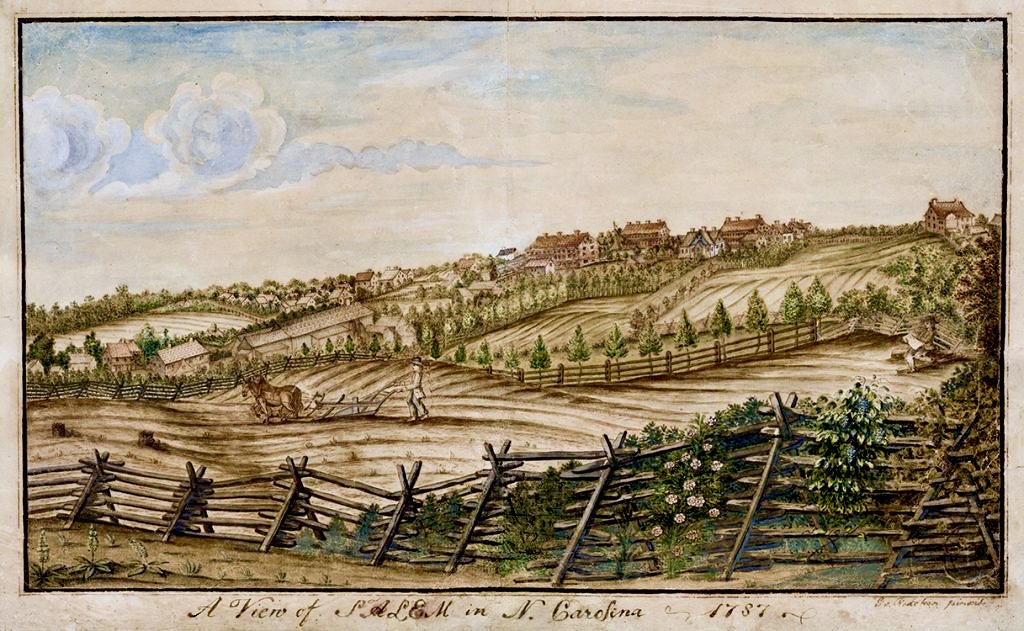
“A View of SALEM in N. Carolina 1787” Fitting Col. Smith’s Description
In continuation from a previous article involving William Loughton Smith’s 1791 journal entries, he passed through Pittsylvania County and progressed upon his journey home to Charleston, South Carolina. “Wednesday, 4th of May [1791]. Descending a steep hill I came to the ferry over Dan River…” The night before he lodged at the nearby tavern of Col. Dix without much of a rest and left to continue his journey early the following morning. “The river is nearly as wide as Staunton and is formidable; the banks wooded and pleasant; it is less rapid than Staunton. Ascending a very steep hill on the other side I entered the State of North Carolina.” After traveling south for twelve miles, he stopped to eat breakfast at a place called Grant’s Store. He later entertained a tour of the Troublesome Ironworks under the operation of Dr. Benjamin Jones. On May 5 he continued south on an awful rutty road. After about eighteen miles the road improved and there were no taverns to be found until he reached Dobson, twenty-six miles from the ironworks, which took him six hours to travel.
Smith’s journey brought him through a unique tract of land near modern-day Winston-Salem known as Wachovia. In 1752, Pennsylvania Germans traveled through Virginia’s Shenandoah into the Carolina backcountry to settle in villages and were known as the Moravian Brethren. Back in Europe, an agreement was reached with John Carteret, 2nd Earl of Granville for the Moravian Church to purchase an enormous region of 98,985 acres (or about 155 square miles) big enough to be considered a county of its own. “After traveling through woods for many days, the sight of this little settlement [Salem] of Moravians is highly curious and interesting. Between 200 and 300 persons of this sect here assembled live in brotherly love and set a laudable example of industry…” The settlement was full of craftsmen as Col. Smith noted, including tanners, shoemakers, potters, saddlers, tinners, brewers, distillers, and more. “The antique appearance of the houses, built in the German style, and the trees among which they are placed have a singular and pleasing effect; the whole resembles a beautiful village, and forms a pastoral scene. On my arrival I waited on a Mr. Bagge, one of the brethren and a respectable old gentleman, who keeps a store here.” He remarked how the locals appeared ardently at work—keeping a garden at every house, the craftsmen preparing hides for leather, firing earthenware, distilling spirits, and building more houses. He explained that the discipline of the people resembled what he had seen in Bethlehem, Pennsylvania. Another notable convenience in the village was that each family had its own private water source, avoiding the need to share a communal well. As Smith observed, “Water brought from the adjacent rivulets is collected in large pipes and conveyed to all the houses.” According to historical Moravian research shared by Winston-Salem Recreation and Parks Department, a handful of different villages formed within Wachovia and Salem became their center of trade in 1772. Col. Smith provided the following statistics in his journal nearly twenty years afterward: “There are in all 1,500 souls; 260 at Salem, 200 at the other two settlements [Bethabara and Bethania], and the residue scattered in different farms. The church yard is on a hill above the town, surrounded by shady groves: the graves are all distinct…it is also astonishing to find the small number of deaths since their first settlement in Salem…” which equated to only three deaths per year. He enjoyed attending their evening church service, “which consisted only of singing, accompanied by an organ” and then retired to “the best bed since I left home.” On May 6 he continued towards the straggling town of Salisbury.
Col. Smith’s entries show that during his time Wachovia was one of the major trade centers adjacent to Danville and Pittsylvania County, not unlike the relationship the two areas still share today. Several archaeological projects have been undertaken to research the original Moravian homes, some of which have been restored or reconstructed to showcase their historical appearances.