
**This research was first published in the January 7, 2026 edition of the Chatham Star-Tribune newspaper as part of Kyle Griffith’s weekly segment entitled “Heritage Highlights.”
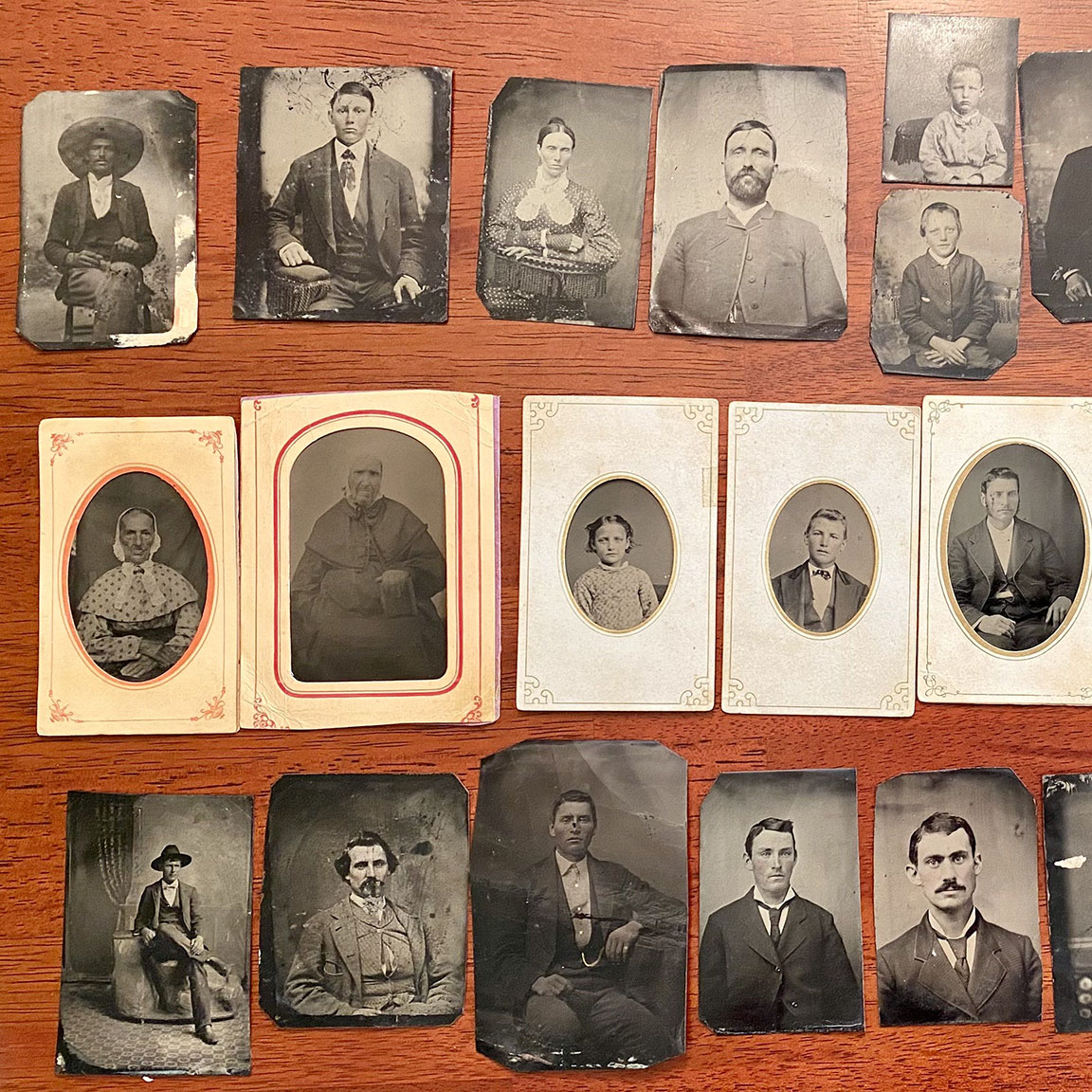
A range of tintypes taken in or near Pittsylvania County during the mid-to-late 1800s.
A large collection of old family photos can raise many questions when it comes to correctly identifying those from the 1800s. There are a few useful dates that will immediately help weed out images that are incorrectly labeled or mistakenly attributed to individuals on genealogy websites. While photography was invented around 1826 in France, it wasn’t until 1838 that technology had improved enough to capture images of people. Photographers began practicing in Virginia during the 1840s, but most working families could not afford a portrait until photography became more accessible in the 1860s. Like chemists, early photographers handled volatile substances with precise timing in order to capture and develop images. Unless the picture is of an older painting, the oldest people ever known to be photographed were born in the 1740s and were about 100 years old at the time of their portraits. If an ancestor was born before 1800 and looks young in a photo, it’s not them.
During the 1840s and 1850s, photographers made daguerreotype (“dah-gare-oh-type”) images on a silver coated copper plate. The portrait was placed in protective leather cases with intricate designs, behind glass, with a velvet cushion facing the image when latched closed. Depending on the angle the image is held at, it will look like a positive or a negative image, and it is clearest when viewed in the reflection of a dark surface. These were different from ambrotypes and tintypes, which were later innovations on photography used mostly between 1860 to 1900. Tintypes (or ferrotypes) are made of iron while ambrotypes are made from glass and appear as transparent negatives unless backed with a dark material. Some were placed in cases similar to daguerreotypes. A lot of old tintypes aren’t labeled, or they once had a labeled paper sleeve that has deteriorated over time. All of these images were one-of-a-kind and not reproducible until decades later. Around 1900 numerous artists copied old photos by hand as large-format charcoal portraits, which often enlarged and stylized the original. Thankfully, by the 1860s, some photographers began creating glass plate negatives used to make prints onto paper mounted on thick cardstock. These durable photos were known as cartes de visite (CDVs) and cabinet cards, most of which carry the name of the studio on the backside.
The best way to estimate the date of a digital historic image is by looking at the clothing. Space doesn’t permit a full description of all clothing styles of the time, but here are a few rules of thumb for clothing that apply to Virginia. Photos before 1860 are distinct in that the men tended to have medium-length hair with a defined side part that covered part or all of the ear, commonly paired with sideburns or a clean-shaven look. The lapels of men’s suits and neckwear are an easy way to identify the decade a photo was taken. Before the Civil War, lapels were very wide, often rounded, and reached to about where the sleeve starts, and were especially paired with a shiny silk or satin waistcoat. Collars reached far up to the jaw and the neckwear of choice was usually a wide cravat, neck stock, or noticeably wider equivalents to bowties. Another detail to note is the fitting of sleeves and pant legs. Suits after 1860 generally have much looser sleeves and wider pant legs, than the form-fitting tailored look of decades prior. By the 1880s and 1890s, suits had very narrow lapels with coats buttoned up near the neck. A wide variety of stiff starched collars such as the wing tip or the banker collar appeared often, and the common necktie had become the primary neckwear that continued into the modern day. The most revealing detail in 1890s portraits are the “leg-of-mutton” sleeves on ladies’ dresses that ballooned out at the shoulder.
The few generalities listed above should be helpful to at least estimate the decade of an undated photo taken in the 1800s. Tintypes became novelty items and with the introduction of film, personal cameras became available as household items rather than something found strictly at studios. While the names of the photographers and subjects may be lost, the material culture offers helpful clues to place the image on a historical timeline.