

**This research was first published in the November 26, 2025 edition of the Chatham Star-Tribune newspaper as part of Kyle Griffith’s weekly segment entitled “Heritage Highlights.”
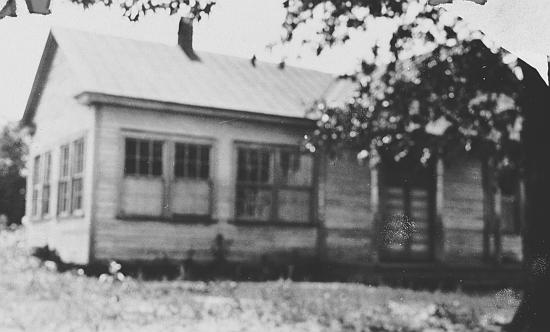
Concord School circa 1929, photo courtesy of Library of Virginia
Concord, a quiet little place west of Tightsqueeze, Virginia was once a self-sustaining community anchored by its church, but the country stores and schools that once dotted the landscape have since closed their doors. The agricultural landscape has been fed by branches of Banister River and Cherrystone Creek for generations. During the late 1700s and early 1800s, much of the land belonged to the patriot Thomas Carter as part of his expansive Green Rock Plantation. In addition, Pigg’s Mill operated a couple miles to the southwest. Some of the early settlers of the Concord area were the Easley, Echols, Fackler, Giles, Harris, Motley, and Scates families.
In his book Remembrances Vol. 5, late historian Pops Osborne remarked that the congregation first met in Fackler School when Concord Methodist Church was founded in 1888. The little school was located a short distance southwest of the old prison building on Concord Road. The first church was constructed around 1890 by members of the community near the current site. A USGS map from 1923 confirms that the first church stood in the empty space between the cemetery and the Tightsqueeze Road. The building was utilized for decades until the need for a new church arose.
Census records from 1910 identified a few of the local farm owners such as Sam Scates, James R. Ragsdale, the Easley brothers (James C., Edward T., George W.), Boss White, Joseph T. Hall, Paul A. Sours, Daniel M. Duncan, and Charles T. Bailey. Harry M. DeMott was a local house carpenter. A merchant named Chesley Hutchins “Chess” Willis had a store that stood in the fork of the road at Concord and W. Giles Road. His wife, former Miss Lucy Riddle was a descendant of the Giles and Fackler families. Near this fork also stood the Concord School on the eastern side of Concord Road. The census listed a few local residents who worked as teachers including Mrs. Mollie B. Easley (née Hall), Mrs. Mary Hall (née Mustain), and Miss Augusta Giles. Further up Concord Road, on the eastern side, was the Simmons farm. Samuel T. Simmons (born in 1865), was an African-American man who ran a store near his house. The old store, while hardly larger than a shed, peeks out from the tree line. It has a classic wooden storefront built on it and served as an important part of the community in its day.
The 1930 census listed Clarence Johnson as an automobile mechanic in the community. His nephew Chesley L. Johnson later opened a service station across from his house and in front of where the old Concord School stood. It was also run by his wife Mrs. Doris Johnson (née Toney) who lived to be ninety-six years old and was buried at Concord cemetery. Other local farmers in 1930 included Chess C. Harris, Solomon Pyrant Easley Sr., Lonnie Easley, Daniel I. Adkins, Charlie J. Ragsdale (who had inherited the farm of his father James), and Charlie Giles. Eventually the Easley family opened a store at the junction of Ponderosa Road.
Into the 1940s and 1950s, many local residents began to get jobs in Danville at the cotton mills. The business of sawmilling had been established for a few decades around Concord and is put into perspective in the 1950 census. A man named Malcolm Dunnavant moved in from Lunenburg County and became superintendent of a plainer mill in the community. Dunnavant employed a workforce of local men, including lumber grader Charlie Lewis, circular saw worker Dallas Booth, plainer operator Charlie S. Jones, log turner David W. White, wood hauler and sawyer Willie G. Barksdale, and other laborers Charles Abbott, Charlie Patrick, and William J. Mullins.
The northeastern section of the community was chosen as a location for a new prison camp, which eventually grew into Green Rock Correctional Facility. After the expansion of Highway 29 in the 1950s and ‘60s, the businesses of Concord fell by the wayside and the crossroads at Tightsqueeze was built up as a shopping center. The current Chatham High School was constructed nearby, and the industrial production plants began to pop up alongside the railroad tracks in the 1970s. This is by no means a full history of Concord, but much of Concord’s story survives only in maps, census pages, and the memories of longtime families.