

**This research was first published in the February 4, 2026 edition of the Chatham Star-Tribune newspaper as part of Kyle Griffith’s weekly segment entitled “Heritage Highlights.”
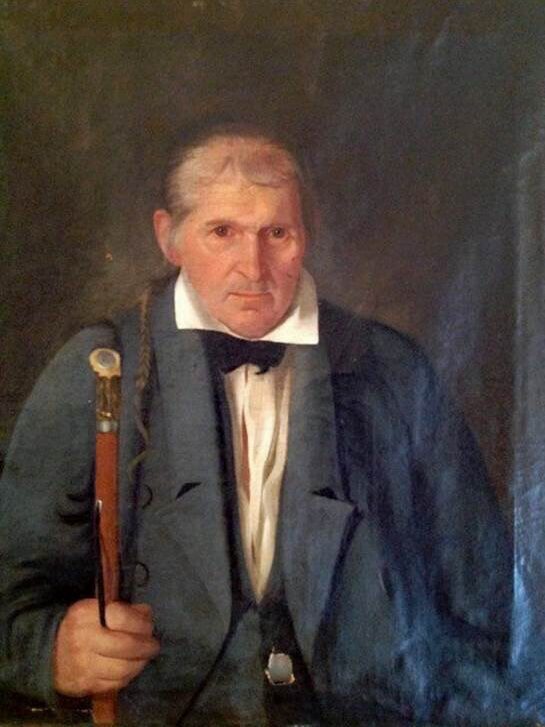
Painting traditionally identified as James Mastin Williams (1763-1838)
Pittsylvania County had many sons who fought during the American Revolution, but most of them remain as little more than names and dates. One of the notable Patriots in local history was James Mastin Williams, born in 1763. His father, William Williams, was an early schoolmaster at the former town of Peytonsburg, which was the county seat of Halifax County until Pittsylvania was formed in 1767. When James was just eighteen years old, he volunteered to enter his local militia. More than fifty years later he appeared before a county Justice of the Peace named Stokley Turner to obtain a pension, he described the details of his military service which remain as a valuable historical resource.
In February 1781, under Capt. Stephen Coleman, their company marched from Peytonsburg to the Dan River, crossed at John Irvin’s Ferry, and joined Gen. Nathanael Greene’s Army in North Carolina. In his own words, J.M. Williams described the rest as such: “Capt. Coleman and the most of his Company were discharged at the high rock in Rockingham County N.C. after which I entered the Service of the United States as a substitute for my Brother John Williams who was a drafted soldier in Captain William Dix’s Company, attached to the Regiment commanded by Col. [Nathaniel Cocke] in Gen’l [Edward Stevens’] Brigade…” General Stevens was wounded at the Battle of Guilford Courthouse. “The Americans were defeated and retreated to Troublesome Iron Works and rendezvoused at that place. I marched from there in the said company with Capt. Dix…to Ramsey’s Mill on Deep River…I was discharged near that place, about the last of March 1781. Then joined Captain Morton’s Company and came as a guard with some British prisoners that were taken at the said mills to Halifax Court House and delivered them to the jailer of Halifax County, Virginia. The time of service rendered was at least 6 or 7 weeks…”
“In the month of July 1781 I enlisted with William McCraw, Deputy Quarter Master for the Southern Army at Peytonsburg, Pittsylvania County Virginia for twelve months and was employed the whole time as a carrier of Public Dispatches & after the term for which I enlisted, had expired, I still remained in the public service for some time. I was employed to take 56 horses from the County of Cumberland in the State of Virginia and carry them to Ashley Hill, in the State of South Carolina. I did so, and delivered them to Edward Carrington, who was Quarter Master General for the Southern Army. The whole time of service rendered in the Revolutionary War was at least fifteen months. I have no discharge that can be found but the service rendered under this enlistment is proved by Robert Ferguson who enlisted in the service with me.” Indeed, Mr. Ferguson was present and confirmed that he fought with him at Guilford and served as a wagoneer transporting goods under Deputy Quartermaster William McCraw at Peytonsburg. Ferguson confirmed “that James M. Williams also enlisted with the said William McCraw and served as a carrier of the e-mail, and other public dispatches for twelve months.” The phrase “e-mail,” of course, referred to express mail, though it reads a bit differently in the twenty-first century.
James survived and returned home to Pittsylvania, where he married Miss Wilmouth “Patsy” Walker in 1784. Together they raised a large family. Over time their descendants became entwined with the growth of new local communities and businesses. Their son Robert W. Williams served as an early mayor of Danville and owned the Arlington Hotel that once stood on Main Street. Other sons and daughters went on to marry into notable local families including the Townes of Danville, Watkins of Cascade, Wooding of Chatham, as well as Neal, Motley, Hurt, and Terry.
A late-1830s painting has been shared across genealogical websites that is said to depict James M. Williams. The portrait shows an aged man seated with an antler-tipped walking stick in his grip. He is clean shaven with a long braid of gray hair draped over his shoulder as a relic of the eighteenth century. Yet, his choice of clothing was quite modern for the time. It’s a rare opportunity to see a likeness of someone from his generation. James lived to be about seventy-four years old and was buried at the family cemetery just west of the Pickaway community in 1838.