

**This research was first published in the April 29, 2026 edition of the Chatham Star-Tribune newspaper as part of Kyle Griffith’s weekly segment entitled “Heritage Highlights.”
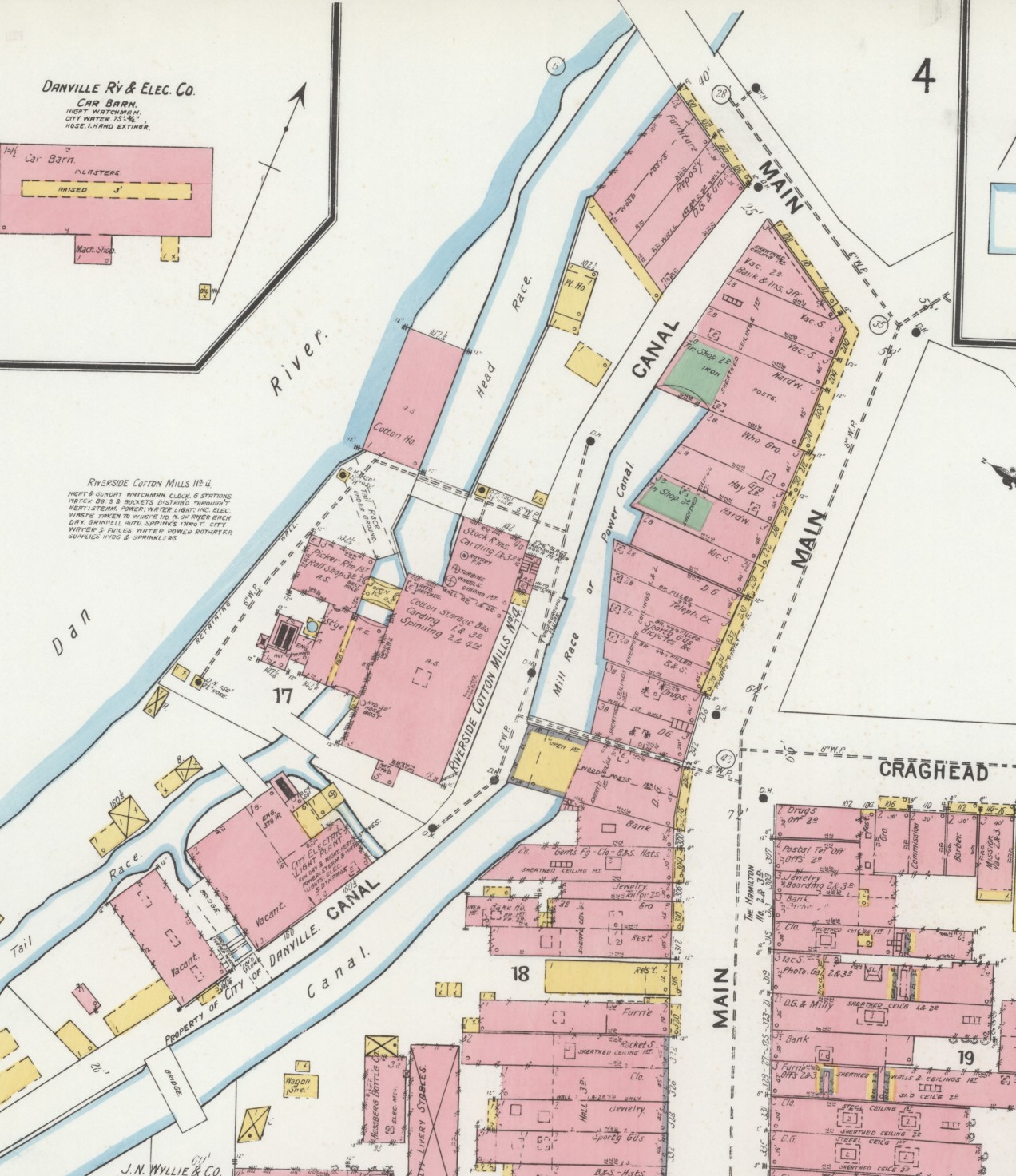
1899 Sanborn Map cropped to show canal (blue) and Canal Street in Danville
In the decades following the establishment of Danville as a tobacco inspection station in 1793, community motives were focused on improving and developing the Dan River as a power source and a shipping route that was more easily navigable. Newspapers from Lynchburg and Richmond over two hundred years ago documented some of the efforts of early Danville industrialist Benjamin W.S. Cabell and his business partner William I. Lewis after they purchased the town’s canal property. An old edition of the Lynchburg Press and Public Advertiser (Vo.1, No. 94) from August 17, 1819 reads, “we will sell to the highest bidder…THE FINE CANAL, thirty acres of low grounds adjoining the canal” where several of the early and significant mills were constructed. “Also, One Manufacturing mill with two pair burs [burrstone mill wheels], & machinery complete. A grist mill for country work, with two pair stones. Three saw mills, two of which are in compleat [sic] order…These mills stand on each side of the south end of the Dan River bridge, where it enters the main street.” Lastly, there were several dwellings and lots for sale “on the main street…where the Roanoke Navigation Company built the locks to their canal.”
Lewis and Cabell provided a promising description of Danville as they could see the potential for the town to prosper with water power and milling in the future. “For commercial and manufacturing purposes, nature has given Danville advantages…it is placed on a large river, navigable for boats, and in the centre of an extensive and fertile country, producing for market, besides wheat of the first quality, grains of all other kinds; tobacco, hemp, flax, wool, cotton, (for home consumption), iron, cast or in bars, tar and turpentine. The great command of water the canal affords, will give Danville almost a compleat [sic] monopoly of the wheat and flour trade of that tract of country, as well as manufactured iron, where the force of water is so necessary.”
Cabell later advertised the previously mentioned buildings for sale in the Richmond Enquirer (Vol. 19, No. 33) from August 30, 1822. He described his property as “that valuable estate, the Danville Mills,” where upwards of one hundred barrels of flour were commonly shipped by batteaux along the Dan River “to the falls of the Roanoke.” He revealed how the nearly completed canal “will open a direct communication with the towns on the Albemarle Sound, and a ready access to Norfolk, the best market for breadstuffs in Virginia. The transportation of flour to the sea-board, will be attended with about the same expense as from similar situations on James River, while wheat can be purchased at from 40 to 50 cents per bushel less, in ordinary crop years…
A vivid description of the physical landscape around the mill followed: “The perpendicular fall in the river from the head of the canal to the mouth of the mill waste is 17 feet, and the proprietors hold the exclusive use of the water except for navigable purposes. The Roanoke Navigation Company are by contract bound to furnish them with 600 square inches of water, the depth of 2 1/2 feet in the canal, as well as to excavate a basin opposite the mills, and to put in locks communicating with the river, which will enable the proprietors to approach the mill door with their boats. Rolling and slitting machinery, tilt hammers, and a nail manufactory might be erected to advantage, and an extensive demand found for the product of their labour, in the upper counties of North Carolina and Virginia, as well as in East Tennessee, where there is a great consumption of such articles and no manufactory exists. Thirty acres of prime cotton land well set in clover adjoining the mills, and a strip of land running down the river comprehending the old ferry landing, will be sold with them.” Lastly, Cabell listed an arrangement of buildings for sale in town including dwellings on Main Street and “a hatter’s shop subject to a lease of three years,” on Bridge Street.
The part of the canal referenced by Cabell and Lewis no longer exists, as it was filled in as part of a renewal plan in 1969. The old canal’s surface was hardened and turned into a road named Memorial Drive. Modern-day Danville businessmen no longer worry about sending batteaux of flour down the river, but many locals are familiar with how important the milling industries were in Danville until recent generations.