

**This research was first published in the March 18, 2026 edition of the Chatham Star-Tribune newspaper as part of Kyle Griffith’s weekly segment entitled “Heritage Highlights.”
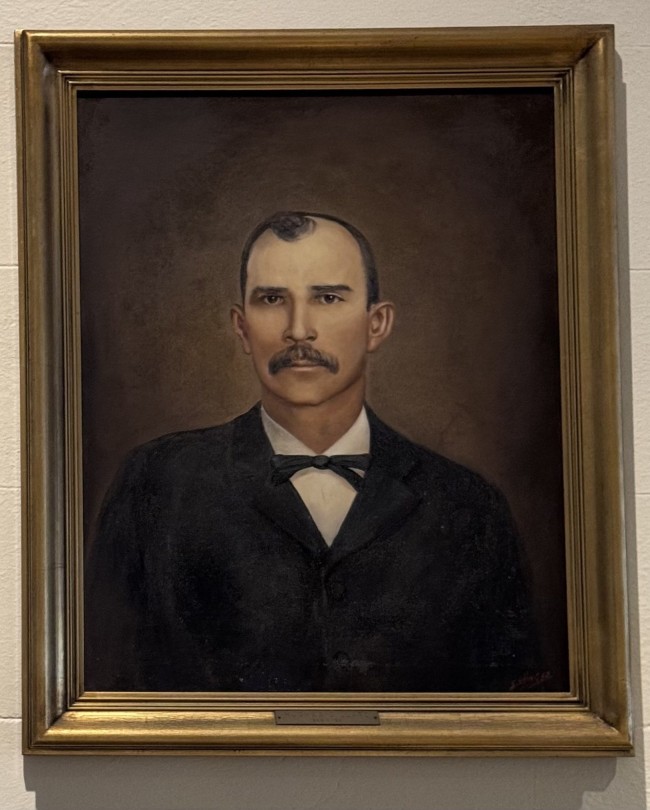
Painting of Judge Hughes Dillard in the Chatham Courthouse
Photographed by Kyle Griffith, 2025
The impressive gallery of paintings in the Pittsylvania Court House has once again inspired research into the lives of those great administrative minds of past generations. This time, a bit of research into the family tree of Hon. Hughes Dillard Jr. revealed his deep roots throughout Pittsylvania and surrounding counties since the beginning. He was born in Franklin County in 1856. His father, often referred to as Col. Hughes Dillard, was laid to rest in the Chatham Burial Park in 1901. A surviving obituary recognized his achievements as a “distinguished criminal lawyer,” noting that he had been on the staff of Gov. Henry A. Wise during the 1850s and had served as Commonwealth’s Attorney for many years in Franklin County. His wife Martha–the judge’s mother–was also born a Dillard. As a young man Judge Dillard attended the University of Virginia and graduated with a law degree. Census records show that he was practicing law in Pittsylvania County by 1880.
In 1886 he married Miss Mattie Clark Wilson, a descendant of the Clark family of Banister River who established Pine Hill and owned a mill that later became Motley’s Mill. The 1900 census shows that Mr. Dillard lived on the property of his father-in-law, Dr. John Wilson near Chatham. Three children were raised from this marriage: Annie G., Elizabeth R., and John W. Dillard. In 1910, Hughes was listed as a prosecuting attorney while living in Chatham adjacent to county sheriff Coleman J. Shelhorse and jailor Raleigh Yeatts. Hughes was not the only judge in his family. In fact, his older brother John Lea Dillard was elected in 1872 to serve as judge of the Henry County Court when he was only twenty-two years old, but he passed away just a few years afterward. Another older brother named Peter Hairston Dillard served as a judge in Franklin County between 1895 and 1932. As one can imagine, Hugh Dillard grew up in this family of lawfully educated minds and dedicated around thirty years of his life as an attorney in Chatham. Information from an article in the World News (Vol 38, No. 37), Judge Dillard “was elevated to the bench by former Governor H.C. Stuart to succeed Judge F.J. Harvey who retired in 1918.” About two years into his term, Judge Dillard’s health began to decline, and after a lengthy illness attributed to pellagra, he died on August 9, 1921. He lived to be sixty-four years old and was buried at Chatham Burial Park.
In terms of Judge Dillard’s ancestry, his name had been passed down in honor of a Revolutionary-era great-grandfather named Col. Archelaus Hughes who owned land in modern-day Patrick County near the South Mayo River. Another great-grandfather of the judge was Maj. John Redd of Belleview, an officer of the Revolution who served closely under Gen. Joseph Martin of Martinsville. This is notable because the descendants of Gen. Martin married into the Hughes and Dillard families. One final note of interest, Maj. Redd’s wife Mary was a daughter of another Revolutionary figure, Col. George Waller, the namesake of a local Sons of the American Revolution chartered in his honor in 1958. Judge Dillard’s paternal grandfather, John Dillard, lived at Font Hill in Henry County and is remembered for his military service as a Brigadier General during the War of 1812. Lastly, the judge’s maternal grandfather was a physician in Henry County named Dr. Peter Hairston Dillard. He doesn’t appear to be a direct descendant of Hairstons, but through the Stovall family he was named for his well-known cousin Peter Hairston of Sauratown Hill.
More than a century has passed since Judge Dillard’s time on the bench. His portrait in the courthouse represents more than his three-year term, but also the generations of service and influence that helped shape him into a respected orator and leader. Had illness not taken him, he would have likely served the county diligently for many more years.