

**This research was first published in the March 4, 2026 edition of the Chatham Star-Tribune newspaper as part of Kyle Griffith’s weekly segment entitled “Heritage Highlights.”
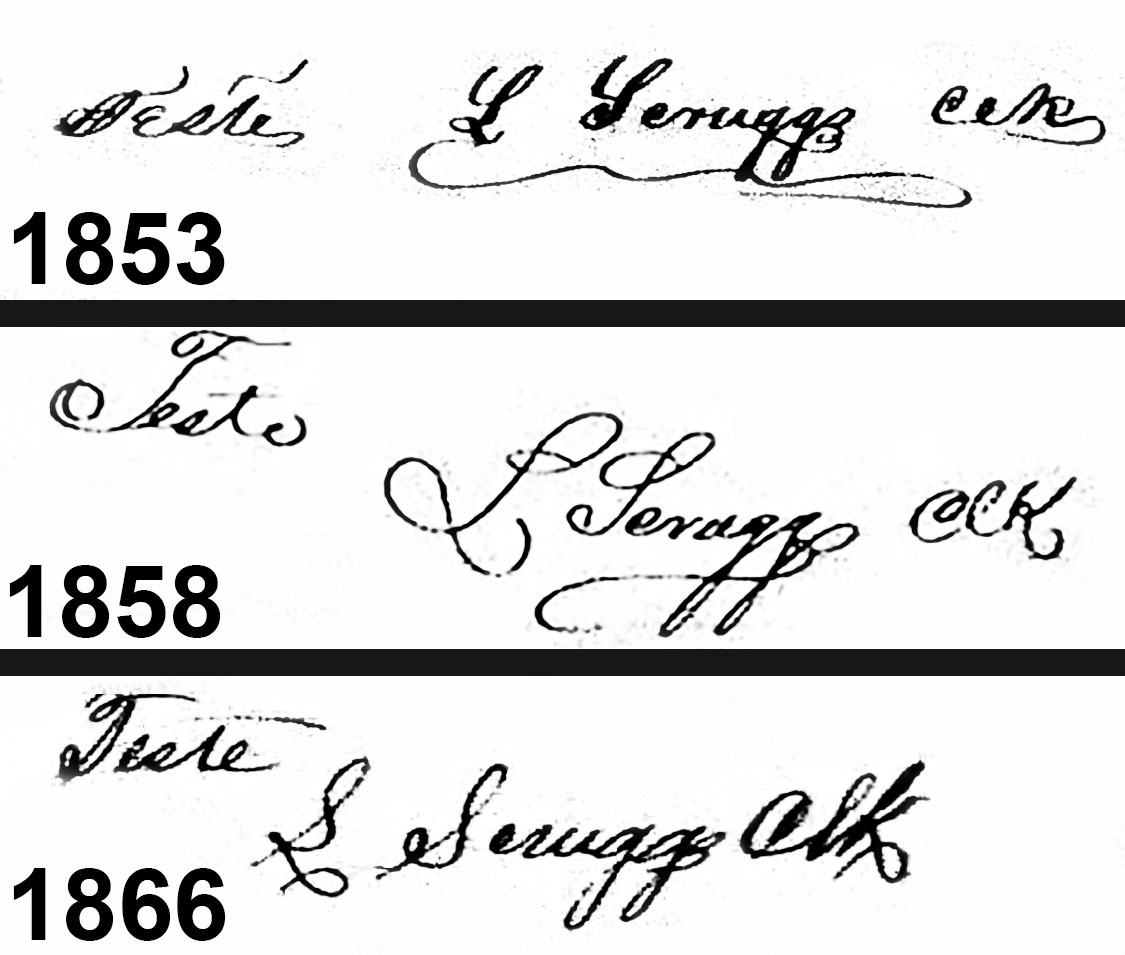
Various signatures of county clerk Langhorne Scruggs through the years
For about twenty-four years, nearly every deed recorded, order entered, or license issued in Pittsylvania County passed through the hands of Mr. Langhorne Scruggs. He was born in 1824 to Drury E. Scruggs and his wife Rhoda, formerly Miss Whitehead. On his maternal side, his grandfather Richard Whitehead (born in 1773) was an ancestor to many of Chatham’s well-known merchants and administrators who share that last name. Langhorne grew up along the Stinking River and his siblings attended school next to Greenfield Church, as mentioned in the journal of their teacher, Mr. William H. Shelton.
When Mr. Scruggs was in his early twenties, he began working as a deputy clerk in Chatham. In 1850, the county divided the clerkship into two offices, one for the circuit court and a new one for the county. Langhorne Scruggs was the first to fill that position as county clerk, while William H. Tunstall stayed circuit clerk. The arrangement remained in place for more than fifty years until 1904, when the county clerk position was dropped and the circuit clerk remained.
In 1859, Langhorne married Miss Mildred Ward Bennett, a daughter of Coleman D. Bennett, who was an early Chatham merchant and member of the House of Delegates. As her middle name suggests, Mildred was a descendant of the Ward family who obtained large landholdings in the northern part of the county and established Ward’s Road before the American Revolution and Ward’s Bridge later on.
The 1860 census listed Langhorne Scruggs as the clerk of the county court. He lived with his wife and two deputy clerks, both about nineteen years of age, named Ross Carter and Edward T. Jones. This association proved meaningful in later years, as Jones’s grandson named his first son Langhorne. In 1872, the Chatham Cemetery Company was founded by a group of local men including Langhorne Scruggs, who served as a trustee under president Richard White and secretary Edward T. Jones. In 1874, Langhorne retired as clerk and was succeeded by Henry P. Jones, a younger brother to Edward.
As of 1870, another young deputy clerk named Conway M. Whittle boarded with them. The 1878 Gray’s Map of Chatham features the road that splits from Main Street, now called Reid Street. The footprints of five substantial homes were depicted, most of which have been greatly altered and expanded since the 1870s. According to the map, Langhorne Scruggs lived in an L-shaped home between Dr. John W. Wilson and George S. Norman. He had the home constructed around 1856. The 1880 census listed Langhorne as a lawyer at home with his wife Mildred and their only child, Miss Sallie Tunstall Scruggs. Soon after, Sallie married a gentleman from Campbell County named Edwin Sidney Reid (Sr.). He later became president of Chatham Savings Bank and is remembered today in the name of Reid Street.
The 1900 census listed Langhorne as a lawyer living with his wife Mildred, daughter Sallie, son-in-law E.S. Reid, Sr., and nine grandchildren, all eighteen years of age and younger. In addition, the family hired a nurse named Mary A. Wilson, a cook named Kate Walker, and a teamster named Pleasant Jones who hauled supplies with a wagon. Mr. Scruggs passed away the following year at the age of seventy-seven and was laid to rest in the cemetery he helped to organize many years before. Several other extended branches of his family and respected acquaintances gave “Langhorne Scruggs” as a first and middle name for their sons during the mid-to-late 1800s. He came to know nearly every major community figure during his time and has left a lasting mark on the town’s history.
In 1901, Sallie inherited her father’s home and Edwin Reid greatly expanded its size, which made it more suitable to their extensive family. The home’s exterior was adorned with all of the most desirable elements of Queen Anne style architecture of the time. The wrap-around porch features a corner pavilion, as well as a turned balustrade and spindlework beneath the roofline. The house has bay windows, a three-part arched window, and a central square tower covered with decorative wood shingle siding projecting from the roof. In recent memory, the building is locally known as “the big yellow house on Reid Street,” and it is unlikely that Mr. Scruggs would recognize it today.