

**This research was first published in the January 14, 2026 edition of the Chatham Star-Tribune newspaper as part of Kyle Griffith’s weekly segment entitled “Heritage Highlights.”
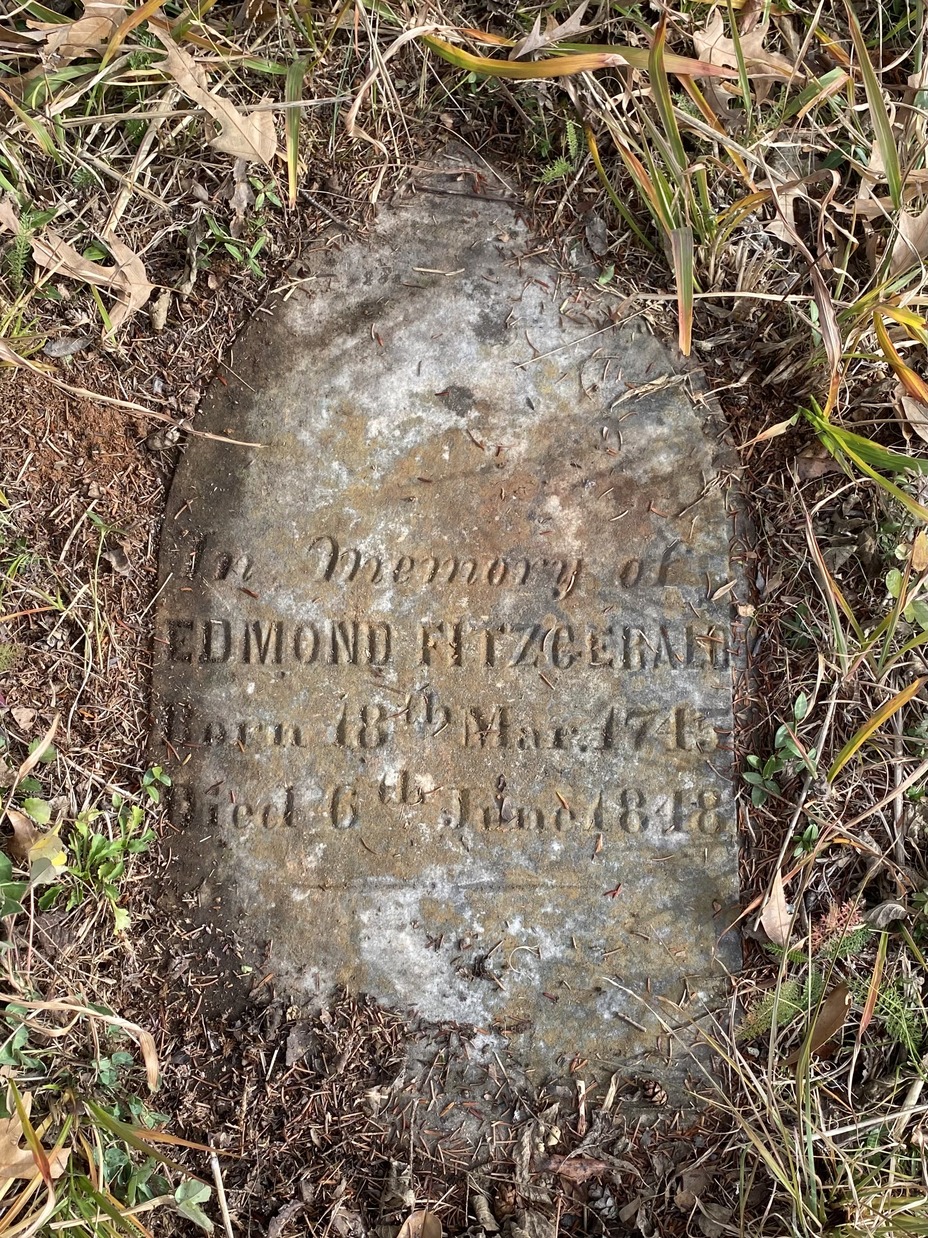
Grave of Edmond Fitzgerald, which states he lived from 1745 until 1848.
Photo by Kyle Griffith, 2022
As Banister River flows off from White Oak Mountain and meanders to the northeast, the lands buffering the water north of Highway 57 were once part of vast holdings by a few founding families during the 1700s and 1800s. The land remains relatively sparse and it is not difficult to imagine the dynamics held between the settlers southeast of modern-day Sheva toward the river. Some of the oldest remaining homes in the area help weave together an understanding of the local landscape throughout the last two and a half centuries. Special acknowledgements are extended to the late Mrs. Madelene Vaden Fitzgerald for the diligent genealogy and deed research she shared to preserve the memories of historic homes in Pittsylvania County.
During the days when our county was mostly wild forest lands and old “Indian fields,” a smart-looking home known as Cedar Hill was constructed overlooking a bend of the great Banister River. One of the neighboring farms was established by the Womack family in the late 1700s and was part of a significant body of farmland a couple of miles from Markham. The Womack’s also had a mill on Whitethorn Creek about two-thirds of a mile from Coles Hill, the historic Coles family home. Around 1803, Rev. James Hoskins Stone built a home called Shady Grove that still stands a little over a mile northwest of Cedar Hill. Rev. Stone married Miss Elizabeth Fitzgerald of Cedar Hill and their daughter Catherine married into the Womack family, who had established their home “Banister Heights.” About a half-mile further west of Rev. Stone, the Clark family established their home “Pineville” and controlled much of the vicinity during the early 1800s. The family patriarch, Col. William H. Clark (born circa 1759) purchased an ideally-situated mill in 1788 that he supervised for about forty years. His son David inherited the business. A road led south from their home to a crossing at Banister River that old maps labeled “Clark Bridge” near a small island in the Banister, across to the mill site.
The Fitzgerald home at Cedar Hill is reminiscent of early Colonial Tidewater dwellings. It features four impressive large chimneys (two on each side) made of local brown and tan stone shaped into large rectangular blocks. Cedar Hill serves as the ancestral home of the county’s Fitzgerald family. It was likely constructed around the time that Edmond Fitzgerald (born 1745) and Millicent Payne were married in 1776. Edmond acquired the land from his father-in-law, Reuben Payne, and raised a family with a list of notable descendants.
Edmond’s son William “Buck” Fitzgerald (born 1791) established a homeplace of his own about a mile to the southwest called “Water’s Edge” near Clark Bridge. The stately two-story home was up to nineteenth century standards. Around 1856 Buck Fitzgerald acquired a nearby mill site previously operated by William H. Clark and Buck’s daughter Nancy Fitzgerald married John William Motley (born 1821) who established a post office at Cedar Hill in 1879. J.W. Motley served for twenty years until his son Thomas Fitzgerald Motley succeeded him. The office ultimately closed in 1901, but T.F. Motley is better remembered for his contributions to the old Clark’s Mill site nearby. Around 1920 he made major renovations to the mill dam and renamed the business Motley’s Mill, which operated into the 1950s. The mill stood until around 2016.
It is lucky that these historic properties were passed down through the generations and still stand. Together they illustrate a prime spot to utilize the county’s water power and land fertility. It’s easy to imagine the hills of tobacco for as far as they eye can see, with clusters of old log barns, and the old draft animals who once populated the county in large numbers. Each of the mentioned farms have endured many lifetimes of adaptation, expansion, renovation, and loss. For those reasons they also serve as great examples of typical middle class American farms that existed in various similar forms throughout the state.