

**This research was first published in the December 17, 2025 edition of the Chatham Star-Tribune newspaper as part of Kyle Griffith’s weekly segment entitled “Heritage Highlights.”
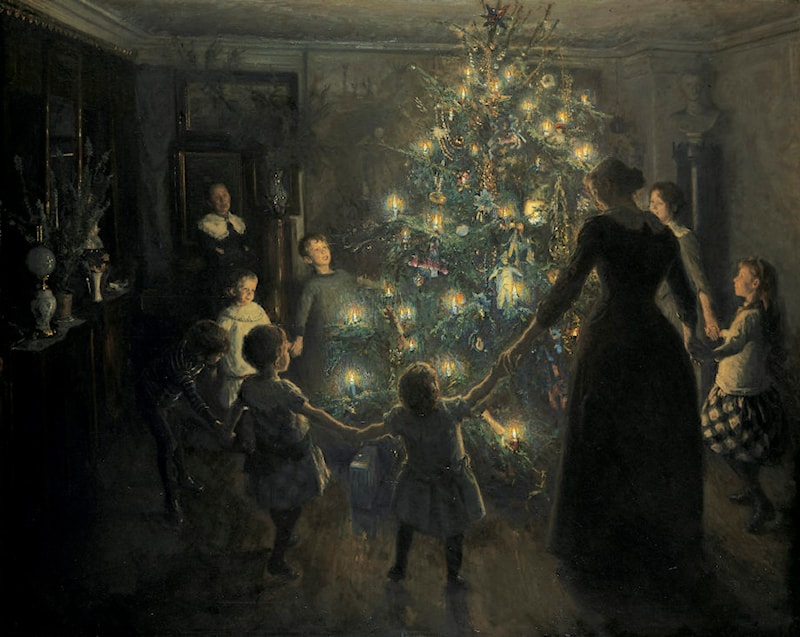
“Glade Jul,” or Silent Night, painted by Viggo Johansen, 1891
When browsing through old newspaper catalogs from the 1800s, one of the earliest mentions of Christmas trees in Virginia was in 1845. Before that, during the 1820s and 1830s, newspapers advertised Christmas and New Years “Holyday” gifts, confectionaries, and get-togethers, but the tree had not yet caught on in the U.S.
The practice of bringing a tree into the house for decoration stemmed from centuries-old German traditions. The tree’s introduction into cultures of the U.S. spurred from the celebrations of the British royal family at Windsor Castle. Starting around 1840, Queen Victoria and her husband Prince Albert (of Germany) brought in fir trees around eight feet tall, with six neatly trimmed tiers of branches. Upon the trees they hung an assortment of candy canes, sugar plums, gingerbread men, all described as “sweet meats” placed in decorative tray baskets.
A story shared in the Alexandria Gazette (Vol.45 No.124) describes scenes witnessed in Frankfurt, Germany of Christmas in 1844: “About the commencement of December, the Christmas market or fair was opened…the figure of St. Nicholas was conspicuous. There were branches of wax candles to decorate the Christmas tree, gingerbread with printed mottoes in poetry, beautiful little earthenware, basket work, and a wilderness of toys…Many of the tables had bundles of rods with gilded bands, which were to be used that evening by the persons who represented St. Nicholas. In the family we reside with, one of our German friends dressed himself up very comically, with a mask, fur robe, and a long tapering cap. He came in with a bunch of rods and a sack and a broom for a sceptre. After we all had received our shares of the beating, he threw the contents of his bag out on the table, and while we were scrambling for the nuts and apples, gave us many smart raps over the fingers. In families the children are made to say ‘I thank you, Herr Nicolaus,’ and the rods are hung up in the room till Christmas to keep them in good behavior.” Later on, while in town to view the Christmas tree: “I ran up the steps with all the children at my heels, and at the top met a blaze of light coming from the open doors, that dazzled me. Much as our anticipations had been raised I had not awaited such a brilliant scene. In each room stood a great table, on which the presents were arranged, amid flowers and wreaths. From the centre, rose the beautiful Christmas tree, covered with wax tapers to the very top, which made it nearly as light as day, while every bough was hung with sweetmeats and gilded nuts. The children ran shouting around the table, hunting their presents, but the older persons had theirs pointed out to them.”
In 1855, a lady from Virginia traveled to Germany and translated a letter sent by a German soldier during the Crimean War, and it was published in the Richmond Daily Dispatch (Vol.8, No.153). “We were disappointed about spending Christmas in Sebastopol” (Russia), he wrote. “…as soon as it was quite dark, we reared our Christmas tree–a half withered little fir–decked with little pitch torches, which we had made ourselves, for wax papers we had none, and with a few parti-coloured paper lanterns. Close under it, each one deposited whatever morsels of the often scanty ration he had been able to spare during the past few days–chiefly crackers and boiled mess beef. We hung on the tree some biscuits [cookies] of better quality, in lieu of the confitures of home; but the grand treasures were two fine apples…”
The old newspaper excerpts shared here are some of the first descriptions of Christmas trees that Virginians would have been exposed to. It was through stories like these that inspired local people to develop their own ideas and ways to celebrate Christmas. The mention of Christmas trees in Virginia newspapers became very common in the decades following 1840.