
**This research was first published in the December 10, 2025 edition of the Chatham Star-Tribune newspaper as part of Kyle Griffith’s weekly segment entitled “Heritage Highlights.”
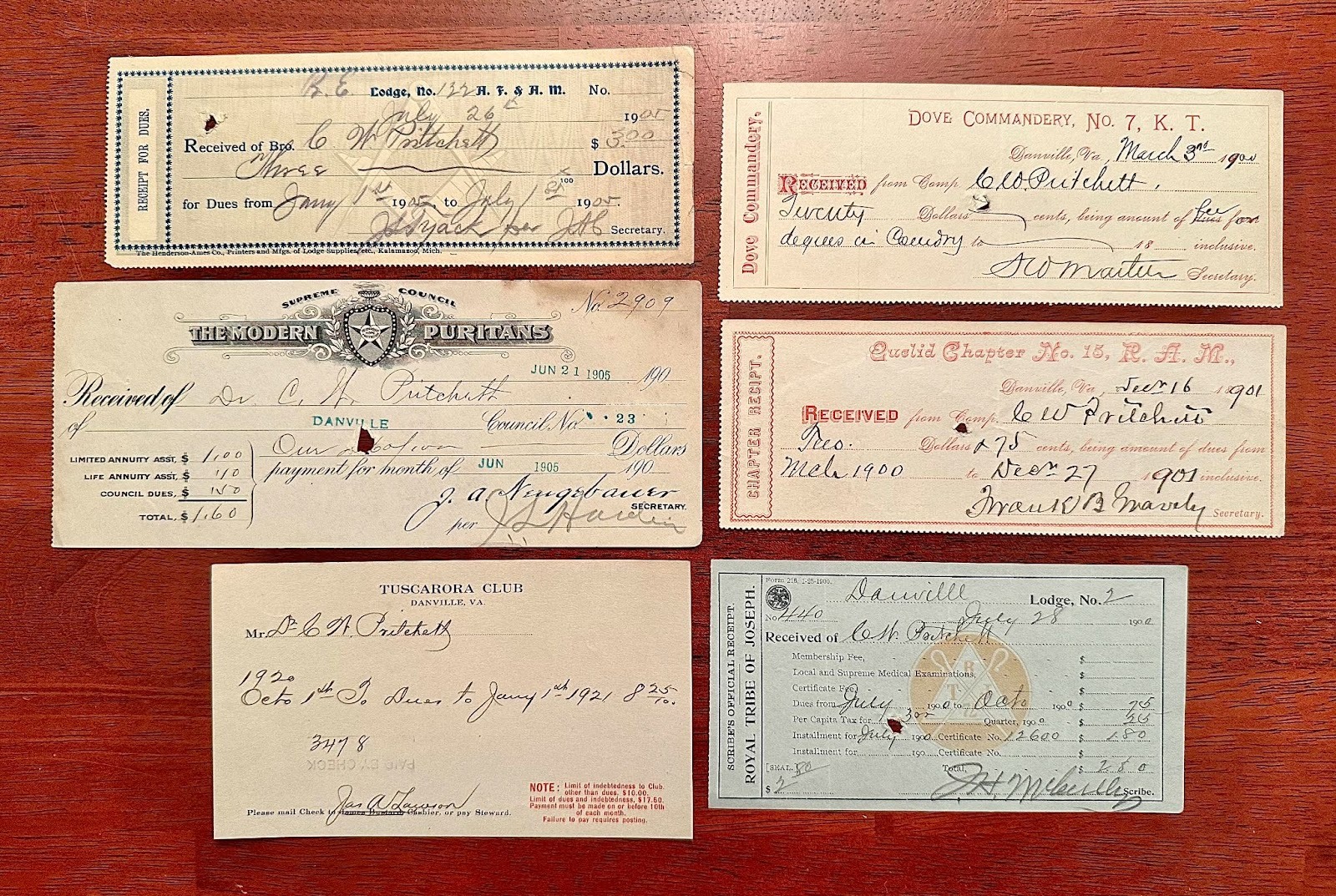
Dr. Pritchett’s dues receipts from the mentioned organizations and societies in Danville
Around the turn of the twentieth century, fraternal organizations were in their prime. Social clubs, benevolent societies, and ritual-based brotherhoods served as the networking center of small cities like Danville. They offered fellowship, insurance benefits, camaraderie, and a sense of belonging to men from different walks of life. A stack of surviving dues receipts from Dr. C. W. Pritchett Jr. (born in 1864) reveals a sampling of the groups that were active in Danville between 1900 and 1921. Some still thrive today, and others have long since vanished.
Foremost, there are dues cards for “Roman Eagle Lodge No. 122 A.F. & A.M.” These Ancient Free and Accepted Masons chartered their lodge in 1820, and it is likely that Dr. Pritchett was an active member during their one-hundredth anniversary in 1920. His membership dues from January 1914 to July 1914 was a total of three dollars, which is equivalent to nearly $100 in today’s value. The receipt was signed by secretary J.S. Tyack.
Secondly, Dr. Pritchett had joined the “Euclid Chapter No. 15, R.A.M.” Royal Arch Masonry is an extension of basic Masonic degrees. Danville chartered this chapter in 1842 under Dr. George Washington Dame. A dues receipt shows that membership from March 1900 to December 27, 1901 cost $2.75, or about $90 in today’s value. Secretary Frank B. Gravely signed at the bottom.
Furthermore, Dr. Pritchett expanded into the “Dove Commandery No. 7, K.T.” Similar to the previous group, the Knight’s Templar is an extension of Masonry. It was chartered in Danville in 1854 under Dr. G.W. Dame as well. In the year 1900 Dr. Pritchett paid to receive his degrees in commandery. The price was a whopping $20, or about $650 in today’s value. Later documents show that dues from July 1902 to January 1903 cost $3 and the receipts were signed by S.W. Martin, recorder.
Outside of Freemasonry, Dr. Pritchett joined a group called the Royal Tribe of Joseph in Danville Lodge, No. 2. The fraternity had been recently organized in 1894 and was headquartered in Missouri. Danville chartered a lodge three years later, and an edition of Richmond’s newspaper “The State” from May 7, 1897 stated that since organizing several days prior, the lodge had seventy-five members noted to be “the most prominent professional and business men.” Dr. Pritchett’s dues from October 1900 to January 1901 cost 75 cents, or nearly $30 in today’s value, and were signed by scribe H.H. Barksdale. The group seems to have been discontinued by 1923.
On the lesser-known side, Dr. Pritchett joined the Supreme Council of the Modern Puritans in Danville Council No. 23. This obscure religious benevolent order doesn’t seem to have been written about much. The dues receipt featured symbolism of a star upon a shield, and on the star is a heart shape that contains the words Friendship, Hope, and Protection. Dues from July 1905 to September 1905 cost 50 cents, or nearly $20 in modern value. Then the secretary was John L. Hardin.
Lastly, a bit different than the others, but Dr. Pritchett also joined the Tuscarora Club, which is not to be confused with the current Tuscarora Country Club. This was a private social club held in an imposing structure that stood in Danville on the corner of Ridge Street and Main Street. From January 1921 to April 1921, Dr. Pritchett’s membership dues cost $8.25, or about $140 in today’s value. James A. Lawson signed the receipts as cashier. The grand Tuscarora Club building was demolished in 1931 to make way for the current post office in Danville.
For one person to have joined all of these organizations is impressive, and it is telling of the valuable connections he must have formed during his time with each of the groups. This is by no means a list of all societies at that time, and it provides a lot of resources for further research. Dr. Pritchett remained in Danville until his passing in 1950 and the preservation of his personal documents is helpful for future generations to understand the type of world he lived in.
Click here to read a short story about Dr. Pritchett’s son, Dr. Bernard Pritchett