

**This research was first published in the December 3, 2025 edition of the Chatham Star-Tribune newspaper as part of Kyle Griffith’s weekly segment entitled “Heritage Highlights.”
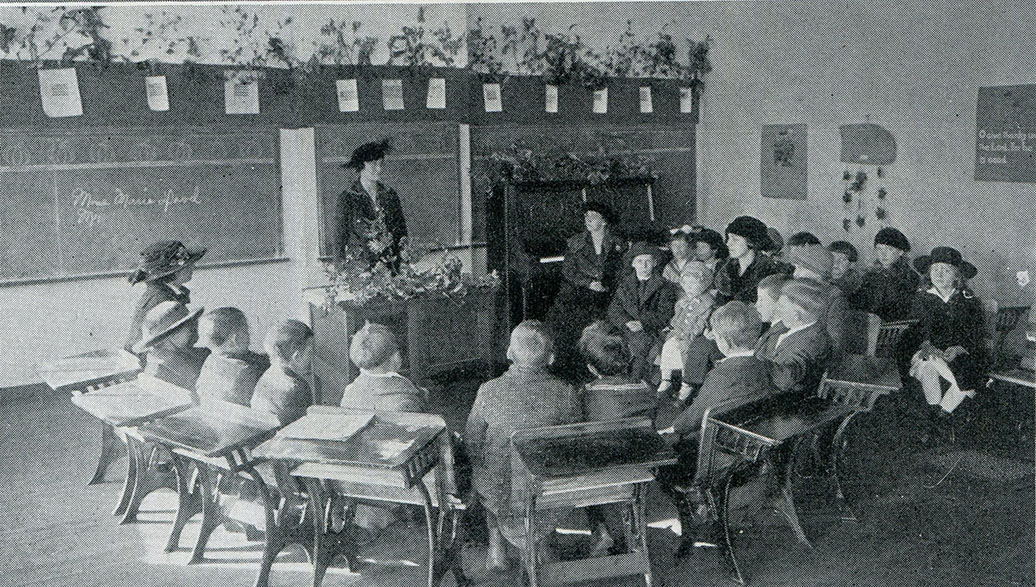
“Model Sunday School” at Whitmell, 1921
Whitmell Farm-Life School helped to establish a standard of rural education that influenced educators far and wide under the leadership of Mrs. Archie Swanson Beverley. Within one of the school’s early yearbooks, The Agricola, the legacy of the Class of 1921 is forever memorialized. The book is an achievement in itself for the times when photography was becoming more accessible. In addition to portraits of graduates and staff, it featured more candid scenes of students, exterior and interior views of the school, parts of the community, social club group pictures, and various distinguished guests from events.
School faculty was listed as follows: Mrs. Archie Swanson Beverley as Principal and also teacher of Sociology, Miss Bruce V. Mohler in Home Economics, Miss Jessie R. Kinnison in Music, Mr. Kenneth Greenfield in Agriculture, Miss Frances Rolton in Mathematics, and Miss Verlie P. Story in English. For the elementary students, Miss Dewey Bradley was Primary teacher and Grammar Grades were taught by Miss Marie Dovel, Miss Jessie Waldron, and Miss Mary E. Barnes.
In all, there were around 150 students at Whitmell at that time, mostly within the primary and intermediate grades. The high school grades had sixteen Freshmen, twenty Sophomores, and only three Juniors. Twelve students made up the Senior class, and their names were Anice Clark Adams, Mary Adams, Margaret Katherine Alderson, Edwin Fuller Burch, Calvin Burton, Lois Lovelace Giles, Evelyn Smith Lacey, Annie May Mitchell, James Swanson Mitchell, Gladys Lilah Motley, Viola Pearl Shorter, and Edgar Thomas Swanson. Back in 1917, there were only nine students who made up the graduating class of 1921. In Sophomore year they lost one student named Della Reaves but gained two more, Calvin Burton and Gladys Motley. Lois Giles joined during Junior year, and Kate Alderson joined at the beginning of Senior year.
From the school calendar, classes started on September 15, 1920 and ran until June 1st of the following year. Early in 1921, the school organized the Whitmell Tobacco Growers’ Association “for the purpose of decreasing the tobacco acreage of 1921, and to learn co-operation through the organizations just as all the other lines of business are organized, with the intention of buying fertilizer at a reasonable price and setting a price on tobacco so that it will enable the farmer to make a small profit.” In six months the club grew to nearly two hundred members with local farmers attending meetings each Thursday to join Virginia and North Carolina farmers to cooperate in finding better profits and by “securing the co-operation of the merchants, bankers, and the manufacturers, the newspapers, and all other business interests.” In March of 1921, the Homemaker’s Club was organized “for the purpose of getting the women of the community together to exchange ideas in regard to the home, to try to make it more attractive, and a more desirable place to live.” Twice a month the club discussed relevant concepts, for example, “The Kitchen as a Work Shop; or Household Equipment and Arrangement That Saves Time and Steps. A City Health Officer in Danville named Dr. Garnett visited to talk about Sanitation of the Farm Home and Schools.
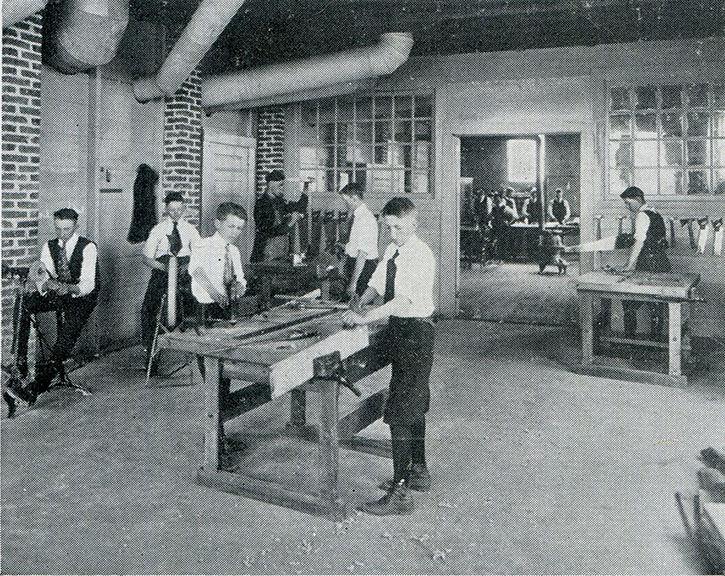
“Our Farm Shop” at Whitmell, 1921
Some of the advertisements at the end of the yearbook were for Danville Lumber & Manufacturing Company, C.H. & J.H. Pritchett General Merchandise, Vass-Watson Corporation in Danville, Paul Realty Company in Chatham, Dan Valley Mills, Dry Fork Milling Company, J.H. Jones Grocery Company in Dry Fork, Oakes & Beck Ford Services in Whitmell, as well as Hotel Burton and Leeland Hotel in Danville to name a few.
To conclude, a thought by graduate Evelyn Lacey speaks for Whitmell’s goals of the time: “Our educational perspective, we justly feel, is a bright one. The relation of school to home is a vital one. The school adapts itself not only to the practical needs of the community, but also seeks to offer a course broadly cultural. We serve. Serving, we feel we are bound to grow!”