
**This research was first published in the November 5, 2025 edition of the Chatham Star-Tribune newspaper as part of Kyle Griffith’s weekly segment entitled “Heritage Highlights.”
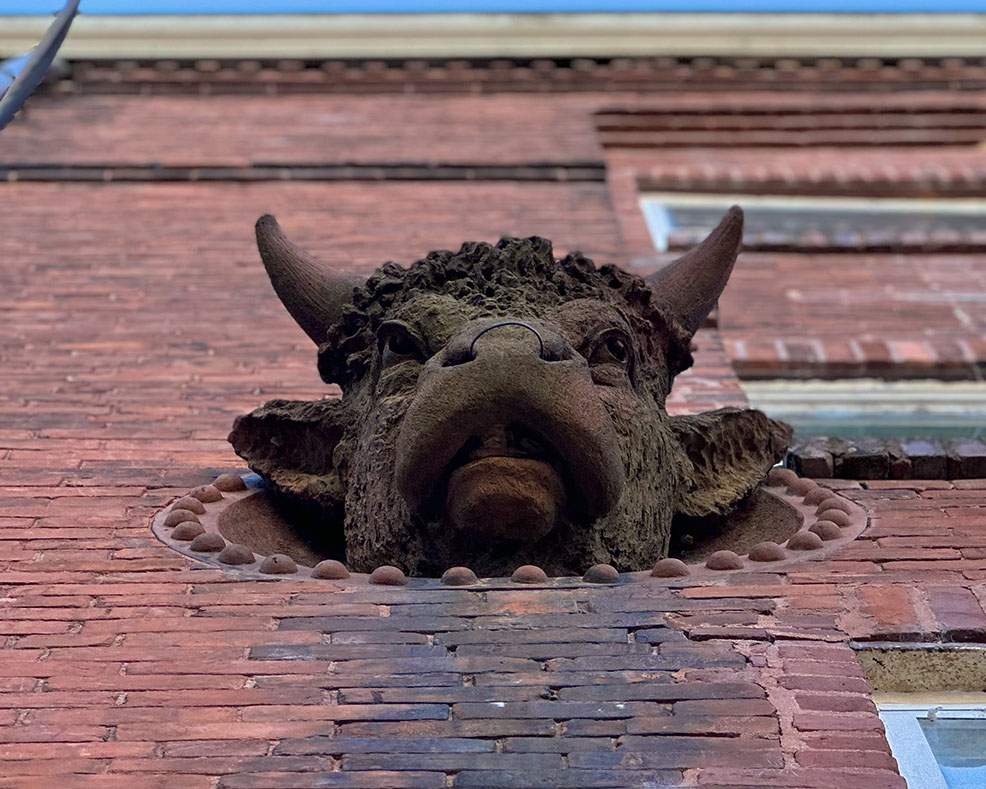
c1890s Terracotta Bull’s Head on North Floyd Street, Danville
In Danville, a very detailed statue of a bull’s head has peered out from the bricks of a tall, old building since the 1890s. It’s easy to miss, located high upon a wall in the crook of North Floyd Street between Main Street and Spring Street. Imagine that the old head could talk and what he would say about the scenes he witnessed over one hundred years ago. Unfortunately, he didn’t tell me anything, but thankfully historic fire insurance maps of Danville hold enough information to describe the environment around the time he was placed there.
One map from 1886 shows that most of the street was empty along the western side, and the eastern side featured an arrangement of small frame houses that were affiliated with a larger brick dwelling used as a boarding house fronting Main Street. On the corner of Spring and Floyd, a steep hill had nothing built on it yet, next to the old Pemberton & Penn Dry Prizery on Spring Street. By 1894 an expansive brick complex was constructed that housed municipal buildings at the corner of Main and N. Floyd, then a vegetable market hall half-way down N. Floyd, and then a fish market at the corner of Spring Street. The terracotta bull’s head was placed next to an impressive rounded arch driveway that led through to the back where market vendors set up. However, modern renovations have removed the rounded archway and placed six additional windows near the bull’s head, and he’s had to stare at an electric pole for most of his life.
By 1904 all but one of the small dwellings along this strip of Floyd were knocked down, and new plans were brewing for the future. The last home was demolished by 1910, and on the steep hill at Spring Street workers constructed a three-story brick building called the Morotock Manufacturing Company, which made workmen’s clothing. In addition, the shape of the road was changed to follow the bend of the western side of North Floyd, and the building’s layout includes a two-story wing with the lunch room, office, and a tall brick tower that held 15,000 gallons of water to feed its emergency sprinkler system (it also had access to city water supply). For its time it was a very modern building that included electric lighting and overhead steam pipes for heating. The old boarding house on Main & Floyd was listed as the “Elk’s Home.” It had become the meeting hall for B.P.O.E. Lodge 227 and was chartered in 1892, according to a sign on the current building. By 1920, the present four-story Elk’s Lodge was constructed and the well-known Elk statue was installed just up the road from the bull’s head. Sometime within that era, as the presence of cars began overtaking the horse and buggy, more hardy roads were needed, especially on the hills of Danville. This part of North Floyd appears to have been laid with buff (light tan) vitrified street paving bricks.
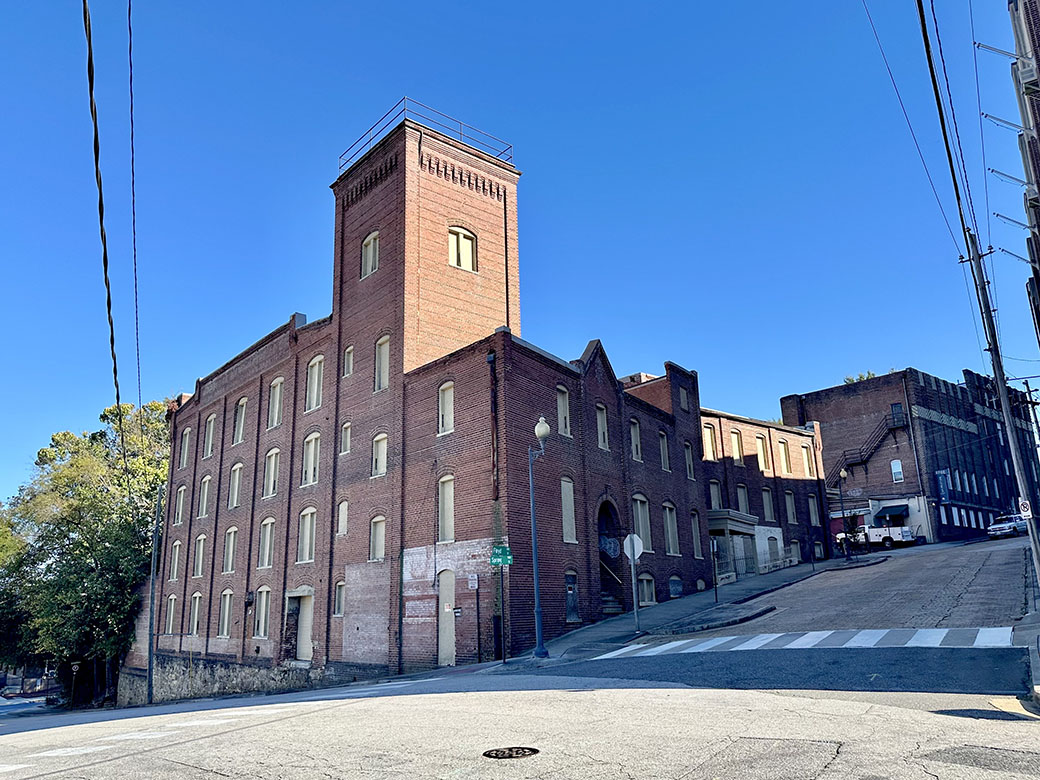
Former Morotock Manufacturing Company Building, Corner of Spring & N. Floyd
In 1927, the old municipal building was greatly expanded to include the nine-story tall Hotel Danville. As of 1954 it also included a movie theatre and a radio studio At the corner of Spring Street, maps describe the present four-story building as the city auditorium, built of steel joist construction and cinder block walls with brick facing. The 1954 map also shows the old Morotock Manufacturing Company as having cigarette manufacturing in the basement and bowling on the second floor, in addition to having an office, dining room, and dressing rooms in section with the water tower.
The old bull’s head has had a long life and has witnessed about five or six generations of people passing through Danville. He may soon have more to witness as plans were announced earlier this year to make the former Morotock building into apartments. The old brick, the interesting stone foundation, and the faint text of the sign hold a lot of character. While Danville is no longer a giant in the cotton milling industry, hopefully the historical integrity of this building can be retained when it is repurposed for the future.