
**This research was first published in the October 29, 2025 edition of the Chatham Star-Tribune newspaper as part of Kyle Griffith’s weekly segment entitled “Heritage Highlights.”
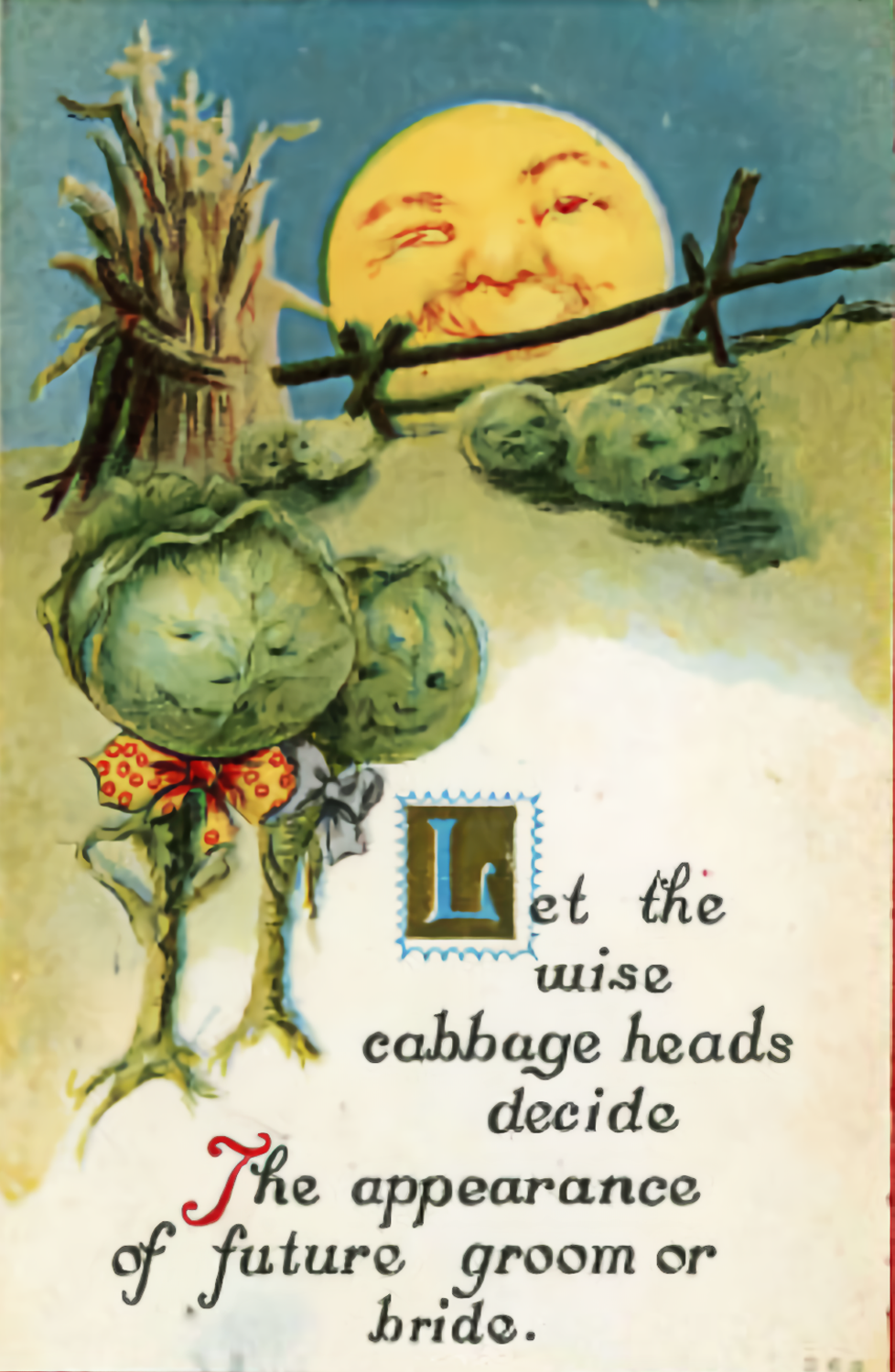
Antique Halloween post card depicting folklore with cabbage heads
The earliest descriptions of Halloween in historic Virginia newspapers often reflect the scenes described in the famous Scottish poem “Halloween” by Robert Burns in 1785. The nights of old All Hallows’ Eve over two centuries ago commenced with many folkloric experiments and activities. Many of the old “spells” and traditions have fallen out of use–perhaps for the better–and Halloween has been a little different for each generation in history.
One such ritual, preserved in oral tradition and Burns’ poem, involved lying silently on a haystack at midnight, hoping to hear the name of a future spouse whispered in the wind, or some say a ghostly vision would foretell. For another rite, a person must be blindfolded, then enter a cabbage patch and pull up the first stalk they find, and the certain qualities of the stalk will reveal what a future husband or wife will be like. Upon viewing the stalk, one would hope for the straighter and nicer looking example rather than an ugly twisted plant, and the sweet or bitter taste of the stem hinted at the success of their future marriage.
Youthful Mischief
Probably the most prevailing trick of the past involved disruptive foolery with unoffending cabbages and the poor front doors of nearby homes. Young “chaps” raided their local cabbage patches, turning the would-be salad into a cannon ball of sorts. In West Virginia, an October 1868 edition of The Wheeling Daily Register announced, “To-night is the anniversary of the well-known Halloween. The little rascals, we suppose, are well prepared with their cabbage heads to hurl at the doors…” However, a quote from The Valley Virginian in 1875 noted that, “Sunday night was Halloween, but we heard of the misconduct of nary a cabbage.” In sharp contrast, during the same year, the Shepherdstown Register shared news from Scranton, Pennsylvania that a young man named Anthony Scanlon was not as lucky, and in an extreme measure lost his life after a boy named Henry Kelly pelted his door with cabbage, then after a confrontation, Scanlon was stabbed by Kelly.
An 1897 edition of The Norfolk Virginian referenced certain tricks pulled by youth throughout the 1800s, stating how many of whom “took to themselves strange and unwarrantable liberties” concerning the personal property of others. “On that night farm gates mysteriously disappeared, public highways were fenced across with rails purloined from nearby fields, black horses were painted white and vice versa, cows were discovered on top of hay stacks munching contentedly away many feet above earth.” The Wheeling Daily Register in 1869 recalled several other “celebrated spells” that were performed on Halloween, sometimes in full belief that they unveil true prophecies. For example: “…wet a shirt sleeve, hang it up to the fire to dry, and lie in bed watching it until midnight, when the apparition of the individual’s future partner for life will enter and turn the sleeve” so it will dry. An article in The Washington Chronicle from 1865 stated that people born on Halloween “are believed to have the faculty of seeing all kinds of beings of the other world, such as ghosts [“haints”], spirits, goblins, &c., and they are also supposed to be born to extraordinary good luck.”
Trick-or-Treating
Newspapers after the turn of the century shifted to the focus of candy, masks, and special “fancies.” Evening parties were described as traditional masquerades with the addition of jack-o-lanterns, card games, bobbing for apples, and all sorts of dancing. By the 1920s, Halloween had taken on a more commercial and communal tone. Canadian newspapers printed the phrase “trick or treat” as early as 1927, and American businesses followed with Halloween-themed marketing. For example, a 1921 ad in the Richmond Times-Dispatch offered free Halloween masks with every loaf of bread purchased at Nolde Bros Bakery. In addition, Chapin-Sacks Corporation offered special flavors of ice cream including pumpkin, apple, and a questionable third option of “ear corn” ice cream. Chocolate mint patties and sweet milk chocolates were offered by the pound for thirty-nine cents. Another article recommended Halloween party hosts to serve guests hot mulled cider with baked apples in it, paired with cookies shaped like witches and frosted with melted dark chocolate. In the decades following the 1920s, the rise of suburban neighborhoods in addition to new individually-wrapped candies paired with ancient folk traditions led to the current culture of trick-or-treat on Halloween night.