

**This research was first published in the October 1, 2025 edition of the Chatham Star-Tribune newspaper as part of Kyle Griffith’s weekly segment entitled “Heritage Highlights.”
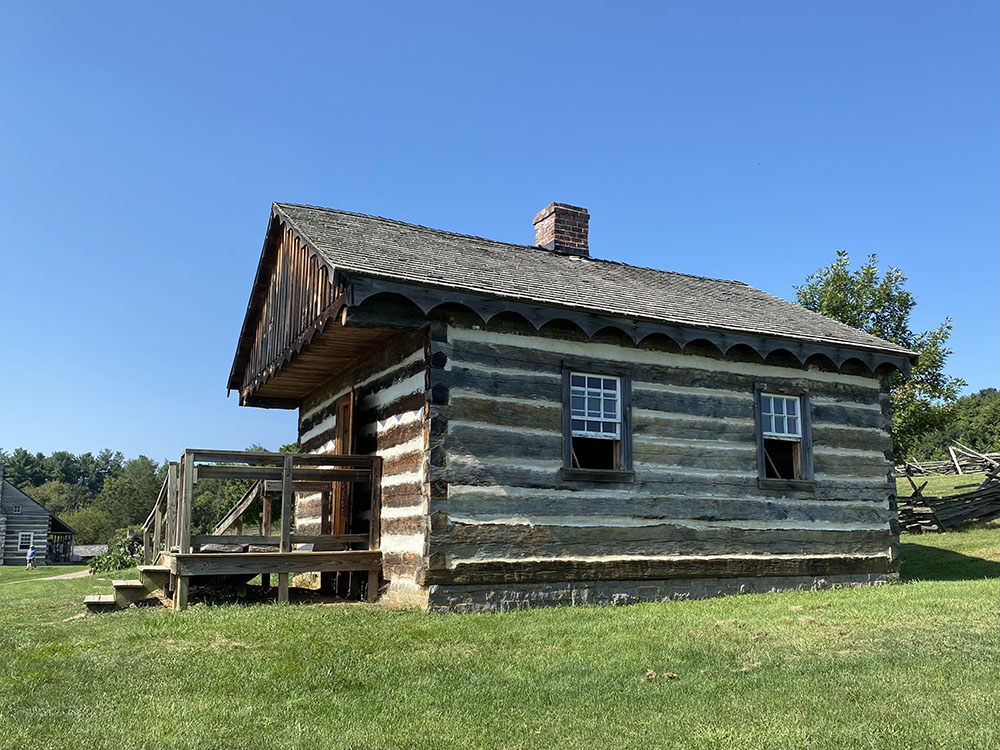
This 1840s school house was likely similar in style to the one at Greenfield long ago.
Photographed by Kyle Griffith at the Frontier Culture Museum, 2022
The discovery of a tattered old journal can be rich with details that bring the past to life. These personal insights help form a better understanding of the social ties that connected local families generations ago. Schoolmaster William C. Shelton, who was born in 1814, recorded a meticulous journal about his experiences living near Greenfield School that was located several miles east of what became Gretna. There, situated between Stinking River and George’s Creek, a handful of formidable farming communities were carved out of the land. In the year 1800, Rev. Griffith Dickenson and 126 fellow Baptists formed a new group that became Greenfield Church. Records show that in 1818 the congregation chose the site of the current church in proximity to a tannery located just to the south.
Old census records indicate that many tradesmen and travelers passed through the community each day as Greenfield had quite a bit to offer by the mid-1800s. Dr. Edward Johns made house calls and helped keep the locals in good health. Elisha Doss and Sam Carter tanned hides upon the creek. Henry Midkiff operated a local mill, William Mays offered his carpentry work, James P. Milam fixed wagons as a wheelwright. Joseph East Jr. built cabinets and Leland East was a stone mason. Miss Sallie Markham made clothing and Lewis Shelton made and resoled shoes. Many of the nearby farmers built legacies for themselves including Andrew J. Whitehead, Joel Mustain, Joel Hubbard, Drury Scruggs, and Jeremiah W. Graves to name a few. Everyone had a role to serve in the furtherment of the community, but among the important jobs were the handful of teachers who offered children the privilege of education during a time and setting where low literacy rates were commonplace. The census listed two teachers at Greenfield: Mr. Elisha B. Thweatt, age 56, and Mr. William C. Shelton, age 35, whose father Vincent owned a couple hundred acre farm adjoining the church property.
W.C. Shelton’s journal began on a wintry first day of a new decade in the year 1850. He had a little school next to Greenfield Church where he taught many of the children of the abovementioned residents. In preparation for the school year, Mr. Shelton hired stonemason William Keatts to fix the chimney on the school house on the 11th, and on the following day Shelton “went down to the tan yard after [a] stone hammer,” got some rock, “and run up a new back in the chimney and daubed up the house.” He mentioned throughout the journal specific items he purchased for students, so it is known that he used textbooks called McGuffey’s Reader in four editions (1st Reader, 2nd Reader, etc.), as well as McGuffey’s Speller, Smith’s Grammar, and Smith’s Arithmetic, all of which were valued between 20 to 40 cents. Students used slate boards and slate pencils, or metallic pens, some of which he purchased from William Pannill’s store. He described buying paper by the “quire,” which is a quantity of about 25 sheets.
The schedule of Greenfield School was not unlike the modern experience. Mr. Shelton held school sessions throughout January to December, with several breaks between, for a total of about ten months. The school met Monday through Friday and the day ran from about 8:00 AM to 4 PM, but on occasion they closed early around noon. He averaged about twenty-five students in class per day throughout the year. Sometimes during awful weather, during preaching, or harvest time in the Fall period, attendance fell as low as twelve, and during the Spring time it was commonly thirty in attendance.
Some of the students he listed included Edward Adkerson, Catherine Dove, Isaac Keatts, Edward Milam, Elvy Mustain, Joel C. Mustain, Billy Scruggs, Jane Scruggs, Powhatan Scruggs, Mary Shelton, Susan A.C. Stone, Martha Turner, David Alexander Whitehead, Maria Whitehead, Wyatt Whitehead, and Tazewell Wooding. Of note, the Scruggs children were younger siblings of the well-known Chatham clerk, Langhorne Scruggs, who lived on what is now Reid Street in Chatham.
A copy of the journal was made by the late Danny Ricketts for the VA-NC Piedmont Genealogical Society in 1995, so they have access to reprint the material. Other copies may occasionally turn up at local book sales. If only similar journals would exist for every nook of Pittsylvania County, but there would be little left to wonder.