
**This research was first published in the July 9, 2025 edition of the Chatham Star-Tribune newspaper as part of Kyle Griffith’s weekly segment entitled “Heritage Highlights.”
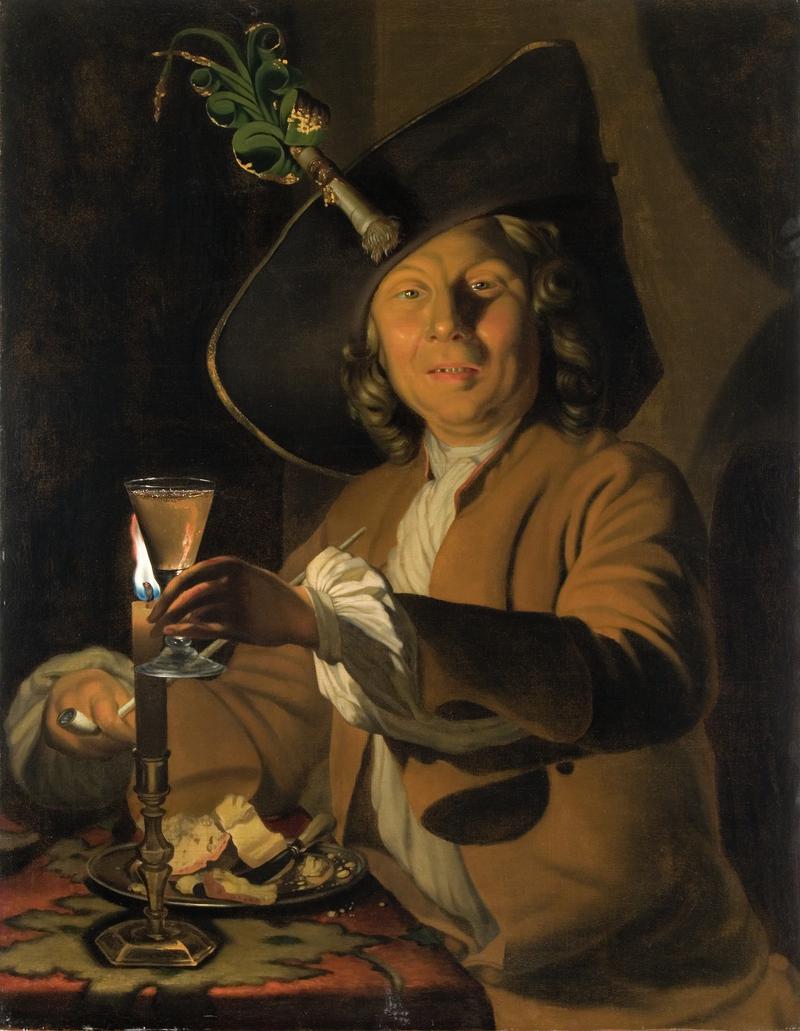
Welshman celebrating St. David’s day with a leek pinned to his hat. He raises his glass above a plate of bread and cheese.
Circa 1750 painting courtesy of Museum Wales
As the place with more castles than any part of the United Kingdom, Wales is commonly absent from the pictures drawn by storytellers of American history. In general, there were few examples of large-scale Welsh settlement within any of the original thirteen colonies, but the main example lies within Pennsylvania. During the 1680s William Penn granted a community of Welsh Quakers whom he called “ye Welsh Friends” about forty thousand acres to the west of Philadelphia. There it was planned to develop a self-governing county conducted in the Welsh language, but the plan failed to materialize past the 1690s. However, several communities within and near Montgomery County, PA still share several real Welsh place names like North Wales, Upper Gwynedd (“Gwyneth”), and Narberth. As a more conspicuous example, there is an interesting old 1730s plantation house called Wales in King William County, Virginia.
Among the surnames in Pittsylvania County that have possible Welsh origins there are Davies, Evans, Griffith, Hywel/Howell, Jones, Lewis, Owen, Morgan, Powell, Price, Pugh, Rhys/Reese, and lastly the surname Welch has origins as a denotation of someone with Welsh ancestry. Many other languages have surnames that indicate the father’s name (patronymic) such as “-son” in Johnson, “O’-” in O’Connor, and “-ez” in Fernandez. In Welsh, the prefix “ap” serves in that manner as seen in the example “Hugh ap Rhys” or literally “Hugh, son of Rhys.” Within a couple generations of a Welsh family settling in Virginia, it’s typical that their name changed to an English spelling. Several examples can be found within the county’s history, whereas “ap Hywel” became the name Powell, “ap Rhys” became Price, and “ap Hugh” became Pugh. About a thousand years ago, the monarch Gruffudd ap Llywelyn served as the first and only king of Wales. His name was pronounced the same as “Griffith.” Centuries later, Welsh settlers with the same name adopted a variety of spellings for the name including Griffin and Griffiths.
In close proximity to the Pennsylvania German settlers and the Great Wagon Road leading from Philadelphia down through the Shenandoah Valley of Virginia, many Welsh families took this path to explore and settle other parts of the country. In 1750, an expedition took place throughout southwestern Virginia by Dr. Thomas Walker. Among his companions was Ambrose Powell (born 1713) who left his mark on the land. They passed through Franklin County and blazed a trail over the Blue Ridge, through the valley, and to the borders with Kentucky and Tennessee. Today in his memory the 195-mile long Powell River flows through the Powell Valley overlooked by the Powell Mountain, which serves as the modern boundary between Lee and Scott counties. His famous grandson perpetuated his legacy in his name, General Ambrose Powell Hill (A.P. Hill). In Pittsylvania County, among the early judges and Revolutionary military commanders there was Col. Haynes Morgan (born 1738). It is thought that his forebears left Wales for Pennsylvania and followed the valley into Virginia where he settled near Banister River of Pittsylvania County.
Historically, the Welsh tended to not settle in very large numbers and after a few generations in Virginia quickly merged into other cultures of British America. In Irish culture, the holiday of St. Patrick’s day prevails, but the Welsh celebration of St. David’s Day each March 1st didn’t find a spot to stay in American culture. In honor of the 6th-century bishop St. David, Welsh families attended special church services and as custom the people secured a leek or a daffodil onto their hats. Festivals called Eisteddfod (“eye-steth-vod”) were usually held for competitive musical and poetic events for bards and folk singers. All enjoyed a traditional feast with foods like bara brith (tea-flavored bread), cawl (soup, usually with lamb, leeks, potatoes, etc.), and glamorgan sausage made with cheese, leeks, and breadcrumbs.
Remnants of Welsh culture are sprinkled throughout the blend of sources that created Appalachian culture and tends to remain quietly tucked away unless one knows where to look. Many have whistled with the Andy Griffith theme song as the old Welsh name appeared on their TV screen. Hints of Welsh influence sing through the fiddle strings of some old-time folk songs and a couple surviving words such as “corgi” and “flannel.”