

**This research was first published in the June 11, 2025 edition of the Chatham Star-Tribune newspaper as part of Kyle Griffith’s weekly segment entitled “Heritage Highlights.”
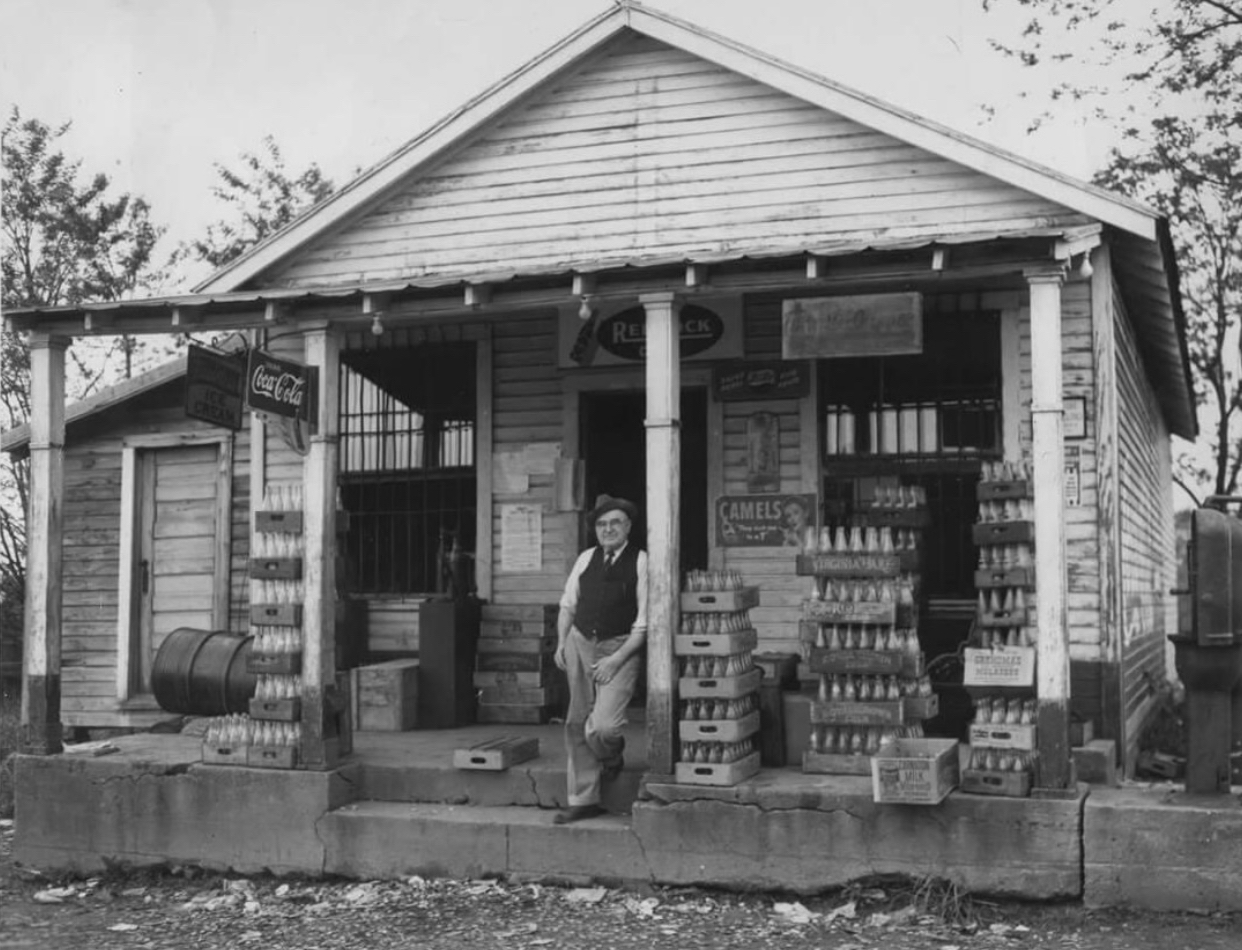
C.A. Pritchett at his store with stacks of returned glass soda bottles, circa 1930
The center of historic Whitmell–like many small rural communities–consisted of its church, school, and stores clustered together along the old country road. For nearly two centuries folks have farmed and built strong family legacies there. Throughout the first half of the twentieth century, C.A. Pritchett’s Store sat next to what is now Whitmell Church of Faith just a few yards to the north. Surviving store ledgers revealed that there had been a store at that location since at least the early 1830s. Thanks to information in James “Pops” Osborne’s book “Remembrances Volume V” (2005), a detailed timeline of the store’s history can be developed, especially from research included by local resident Larry Heldreth. This article, however, focuses on the time period under the Pritchett family’s ownership.
The store was a two-story brick building that was likely constructed in the Federal style under the ownership of William N. Perkins around 1833. The store soon passed to William H. Payne and his father-in-law John Pritchett (born 1788) who purchased the property in 1838. On the first floor they sold a selection of farm produce, fresh meats, spirits, and basic materials while the second floor remained a private domestic space. John Pritchett worked in the store until his death in 1848 and Payne continued the business quite successfully until 1861 when he passed away. Afterward, the store was sold at auction and operated by Payne’s brother-in-law Albert Gallatin Pritchett (born 1819) under the new name “A.G. Pritchett & Son.” Over time, other shops and craftsmen set up adjacent to the store such as woodworker Wyatt Walker. In addition, they turned the second story into the community’s masonic lodge. The store changed hands once again in 1873 to A.G. Pritchett’s son, John Inge Pritchett (born 1850) and the 1880 census confirms they were engaged in “merchandising” together. It is said that the original store was destroyed by an earthquake–probably the one from May 31, 1897 which was centered around Lynchburg and was felt between Georgia and Pennsylvania. A new frame building took its place and John ran the store for over thirty years before his nephew C.A. Pritchett succeeded him.
Claude A. Pritchett was born in 1877 to Claudius Augustus Pritchett and former Miss Martha Beavers. He and his father’s distinctive Latin names honor the ancient Roman emperor Claudius who reigned about two thousand years ago. Choosing such a dignified name suggests an ambition to raise a child with a sense of education, leadership, and legacy. Mr. Pritchett and his cousin Senator Claudius Augustus Swanson both lived up to their names. During both world wars, C.A. Pritchett worked with the Selective Service Board and signed the drafts of many young men who entered the Army. For his community he offered fresh groceries, men’s and women’s clothing, a variety of furniture, hardware, and farming implements. He served as postmaster for over thirty-five years, was a notary public, and taught Men’s Bible Class at Whitmell Church. Mr. Heldreth remarked that “for years the store had the first and only phone which was used at all hours of the day and night for such as recording deeds, emergencies, [etc.].” As the nation entered the Great Depression, so ended the golden years of Pritchett’s Store. The second building burned to the ground in 1932 and was rebuilt for a third time while operations continued under several different partnerships. As he finished his final year as postmaster in 1948, a local newspaper article stated that “Retirement for Mr. Pritchett means only relinquishing his duties as postmaster, not as farmer, businessman, and citizen. ‘I expect to keep going,’ he said.” Claude did continue working for the rest of his life and lived to be eighty-three years old. After more than 120 years of operation under the Pritchett family, in 1960 the store continued under the ownership of Kenneth Holland. It was expanded and developed its own legacy over the following decades, but it too has since been demolished and remains an important chunk of cultural history for the county.